The Conundrum of Columbus Day
Posted by Temmy
Mon, October 13, 2025 10:47am
As we reflect on Columbus Day, we’re reminded that our nation’s history of faith and freedom is also one of contradiction and grace
The idea of “chosenness” and “special blessing” from God has been a constant theme throughout the history of the United States, beginning with the Puritans and their desire that, in the words of John Winthrop in 1630, “wee shall be as a Citty upon a Hill.”
As historian Conrad Cherry writes:
Throughout their history Americans have been possessed by an acute sense of divine election. They have fancied themselves a New Israel, a people chosen for the awesome responsibility of serving as a light to the nations.... It has long been... the essence of America’s motivating mythology.
When we celebrated our bicentennial in 1976 much was made of the faith and piety of the Puritans and the Pilgrims who helped found our nation and the righteous fight against tyranny fleshed out in the American Revolution. As leading historians Mark Noll, George Marsden and Nathan Hatch noted, the idea was that everything about our nation flowed from the Christian actions of Christian people. Then those actions bequeathed Christian values and a Christian heritage. But even as devout Christians themselves, they concluded that this view of history was revisionist at best.
The reality is that the history of early America does not deserve to be considered as being uniquely, distinctly or even predominately Christian. Not if you mean a state of society reflecting the ideas presented in Scripture. This doesn’t mean Christian values were absent from American history. There has been a great deal of commendable Christian belief, practice and influence in the history of the United States and the colonies that formed our country. Christian goals and aspirations were part of the settlement of North America; Christian factors contributed to the struggle for national independence; Christian principles played a role in the founding documents of the United States.
But the larger truth was that we were a religious country, but not necessarily a uniquely Christian one. And even when our forefathers and foremothers were attempting to flesh out Christian principles, they weren’t always very consistent. For example, when you think of the Puritans of the 1600s, do you focus on their desire to establish Christian colonies and live by Scripture, or do you focus on the stealing of Native American lands and their habit of displacing and even murdering those Native Americans when it was convenient?
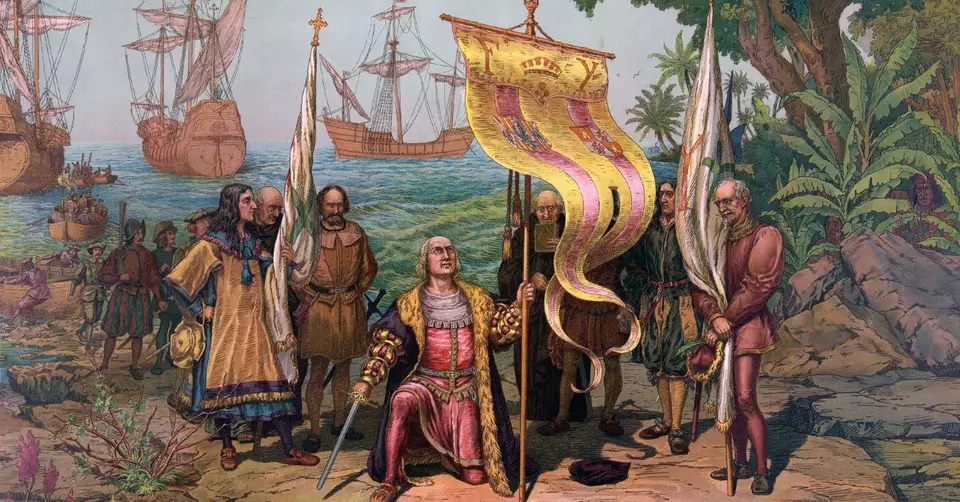
This is the conundrum of Columbus Day, alternatively celebrated as Indigenous Peoples’ Day. It is a federal holiday in the United States, officially celebrating the anniversary of Christopher Columbus’ arrival in the Americas. Even the names of his three ships have become ingrained in our psyche: the Niña, the Pinta, and the Santa María. And, of course, every American schoolchild used to be able to recite, “In fourteen-hundred and ninety-two, Columbus sailed the ocean blue.”
Erroneously or not, the United States celebrates this as “The Discovery of America.” What isn’t debated is that it was the arrival of Columbus and his crew that initiated the colonization of the Americas by Spain, quickly followed by other European powers, as well as the transfer of plants, animals, culture, human populations, and technology.
And...
... the beginning of the displacement of American Indians. Columbus-era documents have clearly shown that Columbus himself, while a brilliant mariner, exploited and enslaved the indigenous population.
As a result, though a federal holiday, many states do not recognize it and have replaced it with celebrations of Indigenous Peoples’ Day. The movement toward replacing Columbus Day with Indigenous Peoples’ Day began in 1992 in Berkeley, California. Many cities have since followed suit. Others, such as Columbus, Ohio, have chosen to honor veterans instead of Christopher Columbus. The main reason for the opposition is the recognition of the suffering inflicted on American Indians with westward expansion. Others oppose it as anti-immigrant nativists who associate it with the immigrants from the Catholic countries of Ireland and Italy.
On this Columbus Day, most Americans will not think about Columbus, the supposed discovery of America, much less the exploitation of indigenous people groups. They will not wrestle with whether Columbus was a part of America being Winthrop’s “city upon a hill.” They will simply embrace a day off from work, perhaps attend a parade that celebrates American-Italian heritage, or simply get away for a three-day weekend.
But perhaps, just perhaps, there is a bit more to think about than what to put on the grill.
Source
|