Thomas Jefferson, the Hypocrite?
Posted by Temmy
Fri, March 27, 2026 11:20am
This year, as America celebrates its 250th anniversary, Breakpoint will examine aspects of the American story through the lens of a Christian worldview. Today, why was slavery established in a country built on such a strong Christian consensus.
Thomas Jefferson is rightly called a hypocrite. In the Declaration of Independence, he wrote the famous lines:
“We hold these truths to be self-evident, that all men are created equal, that they are endowed by their Creator with certain unalienable Rights, that among these are Life, Liberty, and the pursuit of Happiness.”
And yet, Jefferson was among America’s founders who owned slaves. From thousands of his writings on the establishment of the United States, it is clear that Jefferson understood the moral breach. He held aspirations to end slavery, but maintained a different reality. Slavery, he once wrote, is like holding “a wolf by the ear, and we can neither hold him, nor safely let him go.”
According to the Jefferson Monticello project,
He thought that his cherished federal union, the world’s first democratic experiment, would be destroyed by slavery. To emancipate slaves on American soil, Jefferson thought, would result in a large-scale race war that would be as brutal and deadly as the slave revolt in Haiti in 1791. But he also believed that to keep slaves in bondage, with part of America in favor of abolition and part of America in favor of perpetuating slavery, could only result in a civil war that would destroy the union.
A helpful framework to understand the gulf between ideals and practices in America’s founding comes from the eminent sociologist Pitirim Sorokin. He described three types of cultures. Ideational cultures see reality in terms of the eternal and transcendental, with knowledge coming from revelation or mystical experience and values as absolute and eternal. Sensate cultures focus on the material world and emphasize values that are situational and relative. Idealistic cultures combine the two, seeing life as both physical and spiritual, balancing reason with intuition, and with values blending ideals with practical concerns.
Jefferson’s famous line in the Declaration is ideational, an aspiration not yet a reality. On the contrary, the arguments made by pro-slavery factions were sensible. What mattered most was the protection of immediate economic interests. Those who justified slaveholding by appealing to the New Testament argued contrary to over 1,500 years of the Christian doctrine of imago Dei.
For his part, Jefferson did not see a way to maintain his home at Monticello without slavery. He was $100,000 in debt when he died. As such, Jefferson falls into Sorokin’s idealistic category, consisting of the ideal that all people deserve liberty, but are unable to see how to make the ideal a reality. The gradual elimination of slavery was offered as the most common solution, such as what would happen in the northern states.
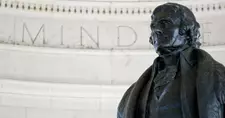
This view is reflected in his words inscribed on the Jefferson Memorial in Washington:
God, who gave us life, gave us liberty. Can the liberties of a nation be secure when we have removed a conviction that these liberties are the gift of God? Indeed, I tremble for my country when I reflect that God is just, that His justice cannot sleep forever. Commerce between master and slave is despotism. Nothing is more certainly written in the book of fate than that these people are to be free.
In the moving film Amistad, John Quincy Adams’ character reflected the nation’s struggle with the ideal of freedom. His words in the film were taken from real historical speeches that the son of John Adams made, including this plea to the Founding Fathers:
We desperately need your strength and wisdom to triumph over our fears, our prejudices, ourselves. Give us the courage to do what is right. And if it means civil war, then let it come. And when it does, may it be, finally, the last battle of the American Revolution.
In fact, the Civil War was fought in defense of the ideals articulated in the Declaration of Independence, however hypocritical its author was. Still, isn’t a culture that has in its creeds that all men are created equal better than a culture that does not? No culture has ever lived up to this ideal, but most throughout history never imagined it as an ideal.
Jefferson’s words in the Declaration of Independence were aspirational, an ideal to work toward. Though the country had a lot to work out, it aimed beyond the moment to a better future. All ideals do, and the best ideals are those anchored in the truth of our creation in the image of God.
Source
|