U.S.-Israeli war with Iran spreads, as Iran's neighbors warn strikes won't "go unanswered"
Posted by Temmy
Tue, March 03, 2026 4:58pm
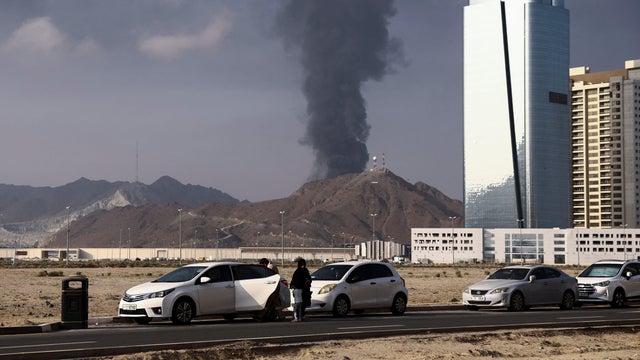
People stand next to a vehicle as smoke rises in the Fujairah oil industry zone following a fire caused by debris after the interception of an Iranian drone by air defenses, according to the Fujairah media office, amid the U.S.-Israel conflict with Iran, in Fujairah, United Arab Emirates, March 3, 2026. Amr Alfiky/REUTERS
What to know on the fourth day of the U.S. and Israel's war with Iran
o Israel sent troops into Lebanon on the fourth day of the U.S.-Israeli war with Iran, as some of Iran's Gulf neighbors warned that its retaliatory fire could draw them into a widening war in the Middle East. Americans have been urged to leave 14 countries in the region "due to serious safety risks."
o President Trump has defended the war as the "last best chance" to address the threat posed by Iran's ballistic missiles and nuclear program, and he warned it could last longer than the four to five weeks he'd predicted earlier. He has not ruled out sending in U.S. ground troops.
o Six U.S. troops have been killed during the war, hit by Iranian fire in Kuwait, while 18 others have been seriously wounded. The Iranian Red Crescent said at least 787 people have been killed in Iran, but reports inside the country suggest the toll is more likely already in the thousands.
Dow plunges 1,100 points
Stocks in the U.S. plummeted Tuesday as jittery investors reacted to the potential fallout from the war with Iran, including the impact on global oil supplies.
The Dow Jones Industrial Average slid 1,110 points, or 2.2%, in early trading, while the S&P 500 and the tech-heavy Nasdaq Composite each dropped 1.9%.
"Global financial markets are in disarray, anticipating a significant interruption in supplies of crude oil and natural gas because of President Trump's war against Iran," Carl Weinberg, chief economist at investment advisory firm High Frequency Economics, said in a note to clients. "The conflict is spreading, and confidence in the continuity of energy supplies is declining in parallel."
U.K. considers sending warship to Cyprus base after Trump lashes out at British leader
The U.K. is deciding whether it will deploy its HMS Duncan warship to protect its Royal Air Force base in Cyprus, after an Iranian drone hit a runway at the base on Monday, CBS News' partner network BBC News reported Tuesday.
The potential move comes after President Trump told Britain's Sun tabloid newspaper that U.K. Prime Minister Keir Starmer had taken a "not helpful" stance on the war with Iran.
The relationship between the U.S. and U.K. was "not like it used to be," Mr. Trump told the Sun, as he praised other European countries, including France and Germany.
"I never thought I'd see that. I never thought I'd see that from the U.K.," Mr. Trump said.
Starmer declined the Trump administration's request to use British bases for offensive operations in Iran, but gave permission for them to be used for what the prime minister called the "defensive purpose" of eliminating Iranian missile installations.
On Monday, Starmer told U.K. lawmakers that "the lessons of history have taught us that it is important when we make decisions like this, that we establish there is a lawful basis for what the United Kingdom is doing. That is one of the lessons from Iraq, and that there's a viable thought-through plan with an objective that can be achieved or has a viable prospect of being achieved. That is the principle that I applied to the decisions that I made over the weekend."
When asked Tuesday whether the U.S. strikes in Iran were legal under international law, Chief Secretary to the Prime Minister Darren Jones said: "It's not for me to comment on the legal basis of actions taken by other countries."
Iran says nobody killed in U.S. or Israeli strikes on suspected meeting to pick new supreme leader
Iran's state media played down an apparent attempt by the U.S. or Israel to blow up a gathering of senior clerics expected to soon pick the country's new supreme leader, following the killing on Saturday of long-time ruler Ayatollah Ali Khamenei.
Iran's Fars news agency said strikes hit buildings in the capital Tehran and the holy city of Qom, but that the Tehran site had been evacuated and the Qom building was no longer in use.
"The grounds of the Assembly of Experts in Tehran (the former building of the Islamic Consultative Assembly) were also targeted by attacks from fighter jets of the terrorist armies of America and Israel," Iran's state-run Fars news agency said Tuesday. "Despite the intensity of the attacks, these buildings had been evacuated in advance, and fortunately, this crime resulted in no loss of life."
Iran's Mehr news agency also played down the impact of the strike, calling the building that was hit in Qom "an old, secondary structure" no longer used for meetings of the Assembly of Experts. The assembly is composed of 88 members who, under Iran's constitution, are tasked with electing the country's supreme leader who alone as the ultimate say on all matters.
Before the strike, Israel's Mossad intelligence agency said in a post on social media, in the Farsi language used in Iran, that it did not "matter who is chosen today; his fate has been decreed. Only the Iranian nation will choose their future leader." The message was accompanied by a graphic depicting senior Iranian clerics being toppled as dominoes.
On Sunday, one day into the war, Iran's Foreign Minister Abbas Araghchi said if the U.S. and Israel's goal was "regime change, that is an impossible mission. The absence or death of the leader does not mean that."
Araghchi told the Qatari TV network Al Jazeera that "state institutions remain in place, and we have constitutional procedures. You may see the election of a new supreme leader within a day or two."
Gas prices rise in U.S. as Iran war widens
The national average for a gallon of gas in the U.S. climbed to $3.11 on Tuesday, according to AAA. It is the first time the average cost of a gallon has risen over $3 since early December.
Fuel costs had already edged higher this year on concern about flaring tension between the U.S. and Iran. The national average a month ago was $2.88, while a week ago it was $2.95.
UAE warns Iran it will respond to "aggression" as it confirms 3 killed in ongoing missile, drone strikes
The United Arab Emirates Ministry of Defense said the country's air defenses had intercepted 11 ballistic missiles and 123 drones on Tuesday alone as Iran continued lashing out at Gulf nations in response to the joint U.S.-Israeli assault.
The ministry said one missile landed in UAE territory but caused no human casualties.
Since the start of what the UAE called "the blatant Iranian aggression" in response to the war, the ministry said a total of 186 ballistic missiles had been launched toward the country, 172 of which were destroyed, while 13 others fell into the sea.
"Additionally, 812 Iranian drones were detected and 755 intercepted, while 57 fell within state territory," the ministry said, adding that eight cruise missiles were also detected and destroyed.
"The attacks resulted in three fatalities of Pakistani, Nepali, and Bangladeshi nationalities, and 68 minor injuries among Emirati, Egyptian, Ethiopian, Filipino, Pakistani, Iranian, Indian, Bangladeshi, Sri Lankan, Azerbaijani, Yemeni, Ugandan, Eritrean, Lebanese, and Afghan nationals," the ministry said.
The statement said the UAE "reserves its full right to respond to this escalation and to take all necessary measures to protect its territory, people, residents, and to safeguard its sovereignty, security, stability, and national interests."
Trump says Iran asked for talks, but he told them it's "too late"
President Trump said Tuesday that it was "too late" for talks with what is left of Iran's ruling theocracy.
"Their air defense, Air Force, Navy, and Leadership is gone. They want to talk. I said "Too Late!" he posted on his Truth Social platform.
In an interview with The Atlantic published on Sunday, one day into the war, Mr. Trump said Iran wanted to talk, "and I have agreed to talk, so I will be talking to them."
Israeli medics say 5 people hurt in latest Iranian missile salvo
Israel's national emergency medical response agency, Magen David Adom, said there were at least two sites in central Israel hit by Iran's latest missile attack, which an IDF spokesperson said earlier involved the use of cluster munitions.
MDA said medics and paramedics were "providing medical treatment to 5 injured, including: a 40-year-old woman in moderate condition with a blow to the head and 4 additional injured people in light condition from glass fragments and blows to the head."
The agency shared images of significant damage to residential buildings at the locations, which it did not give exact locations for.
Israel accuses Iran of war crimes with alleged launch of cluster bombs
An Israeli military spokesman accused Iran of committing repeated war crimes on Tuesday, citing what he said was a new attack on central Israel using "missiles containing cluster sub-munitions" targeting civilians.
"The Iranian regime's war crimes continue," Israel Defense Forces international spokesperson Lt. Col. Nadav Shoshani said in a social media post. He shared with the message a previous statement he posted on the first day of the U.S.-Israeli attack on Iran, in which he also accused Iran of using cluster bombs to target "a densely populated civilian area in Israel."
The IDF said Israel's Home Front Command had deployed search and rescue teams, along with other emergency response personnel, "at the impact sites in central Israel," adding that the "circumstances of the impact are under review."
U.S. embassy in Saudi Arabia warns of "imminent" Iranian missile or drone attack on city of Dhahran
The U.S. Embassy in Riyadh, Saudi Arabia's capital, warned Tuesday of a threat of "imminent missile and UAV attacks" on the far eastern Saudi city of Dhahran, stressing that any Americans in the city should not attempt to come to the American consulate there.
"Take cover immediately in your residence on the lowest available floor and away from windows. Do not go outside," the embassy said in its alert. "The U.S. Consulate in Dhahran urges U.S. citizens in Dhahran to shelter in place, review security plans in the event of an attack, and to stay alert in case of additional future attacks. U.S. Consulate personnel are sheltering in place."
IAEA reports "damage to entrance buildings" of Iran's Natanz nuclear facility from latest strikes
For the first time since the U.S. and Israel launched their joint attack on Iran over the weekend, it has been confirmed that one of Iran's key nuclear sites was bombed.
The United Nations' International Atomic Energy Agency issued a statement Tuesday saying that, "based on the latest available satellite imagery, IAEA can now confirm some recent damage to entrance buildings of Iran's underground Natanz Fuel Enrichment Plant (FEP). No radiological consequence expected and no additional impact detected at FEP itself, which was severely damaged in the June conflict."
Natanz is one of the three major Iranian nuclear sites that the U.S. struck in its Midnight Hammer operation in June last year, which President Trump claimed had "obliterated Iran's nuclear enrichment program.
The IAEA's director general Rafael Grossi warned about a week before the latest war started, however, that "most of the material that Iran had accumulated up until June of last year, despite the [U.S.] bombings and the attacks, is still there, in large quantities, where it was at the time of the strikes."
"Some of it may be less accessible, but the material is still there. From a non-proliferation standpoint, the material remains," he said, citing the hundreds of pounds of enriched uranium still believed to be underground in Iran as a reason for the U.S. and Iran to urgently reach an "agreement that would prevent new military action in the region."
2 U.S. embassies closed, Americans urged to leave 14 countries across Mideast
The State Department is urging Americans to leave 14 countries across the Middle East amid the ongoing war with Iran, which has led to U.S. embassy closures in Kuwait and Saudi Arabia.
The U.S. Embassy in Saudi Arabia was attacked by two drones, causing a small fire and limited damage, the Saudi Ministry of Defense said Monday on X. The embassy urged U.S. citizens in Riyadh and the key commercial cities of Dhahran and Jeddah to shelter in place. It said it would be closed Tuesday.
The U.S. Embassy in Kuwait said it was closed until further notice "due to ongoing regional tensions," and that all consular appointments were canceled. It was closed a day after smoke was seen rising from the mission following Iranian attacks on the country.
Americans were urged late Monday to "depart now" from Bahrain, Egypt, Iran, Iraq, Israel, the West Bank, Gaza, Jordan, Kuwait, Lebanon, Oman, Qatar, Saudi Arabia, Syria, the United Arab Emirates and Yemen. They were urged to leave "using available commercial transportation, due to serious safety risks."
The State Department also told all non-emergency U.S. government personnel and the families of government personnel to leave Bahrain, Iraq, Jordan, Qatar, Kuwait and the United Arab Emirates.
Qatar calls Iranian missile and drone fire a "blatant violation," warns it "will not go unanswered"
Qatar's Foreign Ministry spokesman warned Tuesday that Iran's attacks on the country "will not go unanswered, and today all options are open to Qatar."
Majid Al-Ansari, in televised remarks, dismissed Iran's reasoning to defend its retaliatory fire at Persian Gulf nations that Tehran deems supportive of the joint U.S.-Israeli attack, saying the Iranian missile and drone fire at its neighbor could not be justified.
Al-Ansari stressed that Qatar has consistently sought to avoid regional conflicts while facilitating dialogue between Iran and the international community. He expressed solidarity with other Gulf states and Jordan, which have all come under Iranian fire since Saturday, condemning the attacks as violations of their sovereignty.
"The attacks were targeted directly at Qatari interests and vital facilities inside the country; the targeting was not limited to military or American interests, but also struck Qatari territory," he said, rebutting claims by Iran's foreign minister.
Al-Ansari stressed Qatar's right to self-defense under the United Nations charter and said the small Gulf state was focused on defending its territory.
"This represents a blatant violation of our national sovereignty, a direct threat to our security and territorial integrity, and an unacceptable escalation that threatens regional stability," he said of Iran's strikes. "We retain our full right to respond."
Iran accuses U.S., Israel of war crimes, crimes against humanity with alleged strikes on school, hospitals
Esmaeil Baqaei, a spokesperson for Iran's foreign ministry, accused the U.S. and Israel of war crimes and crimes against humanity on Tuesday over alleged attacks on hospitals and a girls' school.
He said the Gandhi Hospital in Tehran was damaged in an attack "following the bombing of schools and the Massacre of 171 innocent girls in the city of #Minab."
On Monday, the World Health Organization said it understood "patients were moved due to nearby explosions that caused collateral damage to the hospital," Reuters reported. The WHO also said it was working to verify reports of three other medical centers being hit.
Witnesses told Reuters on Sunday that the Gandhi Hospital was hit by Israeli strikes.
Baqaei said the alleged attacks on civilian infrastructure came "despite the aggressors' claims of possessing the most advanced military hardware and precision-targeting systems. The deliberate targeting and destruction of civilian infrastructure, medical facilities, schools, and media institutions by the #UnitedStates and #Israel, with the aim of paralyzing civilian life, constitute blatant war crime and crimes against humanity. No responsible state can remain silent in the face of these atrocities," Baqaei said.
CBS News asked the Israeli and U.S. militaries again Tuesday for any comment on the strike that allegedly hit the school in Minab. The IDF did not reply, and the U.S. military's Central Command told CBS News it had no statement to share on the reports.
Iran's retaliatory attacks on its neighbors could backfire, leaving it trapped in a wider regional war
Six Persian Gulf nations appear to be on the verge of ending their neutrality in the U.S. and Israel's war against Iran, after accusing Tehran of "reckless and indiscriminate attacks" on their territories.
The Gulf Cooperation Council said Sunday that it maintained the "option to respond to Iranian attacks" to protect security in the region. It was just one sign of a potential major escalation in the conflict sparked Saturday by the joint U.S.-Israeli assault on Iran.
Saudi Arabia's Ministry of Defense said the U.S. Embassy in Riyadh sustained "minor material damage" after being hit by two Iranian drones. That came a day after an Iranian attack targeted the vast Saudi Arabian oil refinery at Ras Tanura — the biggest such facility in the country and one of the biggest in the world.
Iran has shocked the region by firing hundreds of missiles and drones at every state across the Persian Gulf, hitting luxury hotels in Dubai and Bahrain, residential areas in Doha, Qatar, military sites and energy infrastructure in Kuwait, and vital seaports and waterways in Oman.
All these nations host major American military bases so, by default, they are in the American camp in Iran's view. Iran's foreign minister has said repeatedly that the Islamic Republic's fight is not against its neighbors, but against the U.S. military assets they welcome.
Tehran's aim with the missile and drone fire has likely been to pressure the Gulf's monarchies to push their allies in Washington to end the war, but the Iranian calculus appears to be backfiring.
After Qatar's air force shot two Iranian bombers out of the sky for the first time, there was a clear risk that other countries would decide to join in a war threatening to spread quickly across the Middle East's long-peaceful Gulf region.
Why is the U.S. attacking Iran? Here's what the Trump administration has said motivated the strikes
Before the U.S. launched its joint attack on Iran, in close coordination with Israel, President Trump had expressed frustration with progress in what were ongoing talks over the Islamic Republic's nuclear program.
On Monday, Mr. Trump articulated the reasons he said he had decided, despite the ongoing diplomacy, to order U.S. strikes on Iran, sparking what he says may well be a weeks-long war.
In his first live public remarks on the operation, he offered four core reasons for the campaign:
o Destroying Iran's missile capabilities;
o Annihilating Iran's navy;
o Preventing Iran from developing nuclear weapons;
o Ensuring the regime can't continue to arm, fund or direct "terrorist armies" outside its borders.
A senior administration official said the operation would continue until all four objectives are achieved.
Israel sends troops into Lebanon, tells residents in some 80 Lebanese communities to evacuate
Israel's military warned people in at least 80 southern Lebanese cities, towns and villages to evacuate and not return on Tuesday as it announced that troops had been sent across the border into the neighboring country "to create an additional layer of protection for our towns."
"Forces have begun an operation to thicken the line of defense for northern communities. As part of this, we evacuated the Lebanese population for their own safety. We have deployed forces across the border, holding several strategic points along the border," the Israel Defense Forces said in a statement, adding that it had "achieved operational control in the area, with combatants prepared to act against any threat."
Israel has hammered the Iranian-backed Hezbollah group in Lebanon for years, and with the U.S.-designated terror group joining Iran's retaliatory attacks against perceived Israeli and U.S. interests across the region in the last few days, Israel had indicated that a new ground operation could be coming.
"We continue to strike Hezbollah's centers of gravity in Beirut. Overnight, we completed a wave of strikes on Hezbollah's intelligence headquarters," the IDF said Tuesday, adding that "the ongoing activity, in cooperation with the U.S., will continue to deepen the damage, eliminate launchers, and reduce their numbers as part of the operation's goals."
Israel warns of another Iranian missile launch
The Israel Defense Forces warned Tuesday morning of a new Iranian missile launch and urged people to heed orders from the country's Home Front Command to seek shelter.
"Defense systems are operating to intercept the threat," the IDF said, repeating warnings that have been issued multiple times daily since the U.S. and Israel launched their blistering attacks on Iran Saturday morning.
Red alert sirens were reportedly blaring across central Israel, including in the capital Tel Aviv, and there were unconfirmed reports of at least one impact but the nation's emergency MDA medical service said there were no immediate casualties confirmed.
The MDA said teams were treating two people injured "on their way to a protected area," but it didn't indicate the injuries were serious, or the result of the Iranian fire.
U.S., Israel hope to destroy up to 80% of Iran's ballistic missile launchers by week's end
The assessment by the U.S. and Israeli militaries as of Monday was that they had destroyed roughly half of the 500 or so missile launchers Iran had before the American "Midnight Hammer" attacks on the Islamic Republic's nuclear facilities in June. They estimate that Iran could still have around 250, but they believe that by the end of the week, 70-80% of the country's launchers will likely have been destroyed.
The last of Iran's missile launchers may be harder to reach because many are underground.
The assessment was that Monday saw notably fewer ballistic missile barrages due to Iran's diminished launching capacity, but it was also likely that the country is trying to ration its stockpiles, given President Trump's remarks that the war could last five weeks or longer.
America's Gulf allies intercepting hundreds of Iranian missiles and drones
U.S. allies in the Persian Gulf have faced a significant bombardment from Iran since the start of the U.S. and Israeli war on the Islamic Republic on Saturday.
Qatar's Ministry of Defense said that as of Monday it has successfully intercepted 90 ballistic missiles, 24 drones, three cruise missiles and two Su-24 fighter jets.
Kuwait's Ministry of Defense said Monday that it had detected 178 ballistic missiles and 384 drones since the start of the war, according to the country's official news agency. Some 27 members of the Kuwaiti army have been injured, the ministry said.
Six American service members have been killed and 18 seriously wounded in the U.S. military's Operation Epic Fury as of Tuesday morning, according to U.S. Central Command spokesperson Capt. Tim Hawkins.
U.S. Embassy in Saudi Arabia attacked by drones
The U.S. Embassy in Saudi Arabia was attacked by two drones, the Saudi Ministry of Defense said on X, causing what the ministry described as a small fire and limited damage.
The apparent drone attack in the Saudi capital of Riyadh came as several U.S. allies in the Gulf region face days of retaliatory attacks by Iranian drones and missiles, following U.S. and Israeli strikes on Iran.
The embassy has urged U.S. citizens in Riyadh and the key commercial cities of Dhahran and Jeddah to shelter in place. It said it would be closed Tuesday.
Trump says "you'll be finding out very soon" when asked who now controls Iran
In an interview Monday night, President Trump said that "you'll be finding out very soon" when asked who now controls Iran.
Speaking to NewsNation's Kellie Meyer, the president also reacted to the strike on the U.S. Embassy in Riyadh, Saudi Arabia, saying "you'll find out soon" when asked about retaliation for that attack.
U.S. Embassy in Kuwait closed indefinitely over "regional tensions"
The U.S. embassy in Kuwait on Tuesday said it was closed until further notice, a day after smoke was seen rising from the mission following Iranian attacks on the country.
"Due to ongoing regional tensions, the US Embassy in Kuwait will be closed until further notice. We have cancelled all regular and emergency consular appointments," the embassy said in a statement on X.
Trump says wars can be fought "forever" with U.S. weapons stockpiles
President Trump said late Monday on Truth Social, "The United States Munitions Stockpiles have, at the medium and upper medium grade, never been higher or better," and that the U.S. has a "virtually unlimited supply of these weapons. Wars can be fought 'forever,' and very successfully, using just these supplies."
"At the highest end, we have a good supply, but are not where we want to be. Much additional high grade weaponry is stored for us in outlying countries," Mr. Trump added.
Mr. Trump has predicted the war in Iran could last at least five weeks, and he has not ruled out the possibility of putting American boots on the ground in Iran.
U.S. adds UAE to nations where non-essential personnel being evacuated
State Department evacuations of non-emergency personnel and family reached six nations Tuesday with the inclusion of the United Arab Emirates.
The other nations where that's happening are Bahrain, Iraq, Jordan, Kuwait and Qatar.
The UAE, home to Dubai and Abu Dhabi and long considered a safe corner of the Middle East, has been dragged into the Iran war with and attacks on its territory and missile interceptions.
In addition, the U.S. ambassador to Israel, Mike Huckabee, has advised Americans there about what he calls "VERY LIMITED" options for leaving, mainly via bus to Egypt, using his X account, saying, "We are getting a lot of requests regarding evacuating from Israel from American citizens who are currently in Israel or who have family here."
Trump submits War Powers Resolution notice to Congress
President Trump on Monday submitted a War Powers Resolution notification to Congress regarding the Feb. 28 military strikes against the government of Iran.
"Despite my Administration's repeated efforts to achieve a diplomatic solution to Iran's malign behavior, the threat to the United States and its allies and partners became untenable," Mr. Trump wrote to Senate President Pro Tempore Chuck Grassley in the March 2 letter, obtained by CBS News.
Mr. Trump writes that "at my direction," U.S. forces conducted precision strikes against "numerous targets within Iran," including ballistic missile sites, maritime mining capabilities, air defenses and command-and-control capabilities. The strikes, he writes, were undertaken to protect U.S. forces in the region, protect the homeland, ensure the free flow of maritime commerce through the Strait of Hormuz and act in collective self-defense of U.S. allies, including Israel.
The president states that no U.S. ground forces were used and that the mission was designed to minimize civilian casualties, deter future attacks and neutralize Iran's malign activities.
He acknowledges in the letter that "it is not possible at this time to know the full scope and duration of military operations that may be necessary," adding that U.S. forces remain postured to take further action as needed.
The president wrote that he directed the action pursuant to his constitutional authority as commander in chief and is submitting the report consistent with the War Powers Resolution.
Trump says U.S. can go "far longer" than 4-to-5-week timeline in Iran
President Trump reiterated in remarks at the White House on Monday that the U.S. is "substantially ahead" of its time projection for the operation in Iran, but added that the military was prepared for a longer campaign.
"Whatever it takes, we will always — and we have right from the beginning, we projected four to five weeks, but we have the capability to go far longer than that," he said. "We'll do it."
Mr. Trump also rebuffed a claim from an unidentified person. The president said the person alleged he would soon get bored of the military operation.
"I don't get bored. There's nothing boring about this," Mr. Trump said.
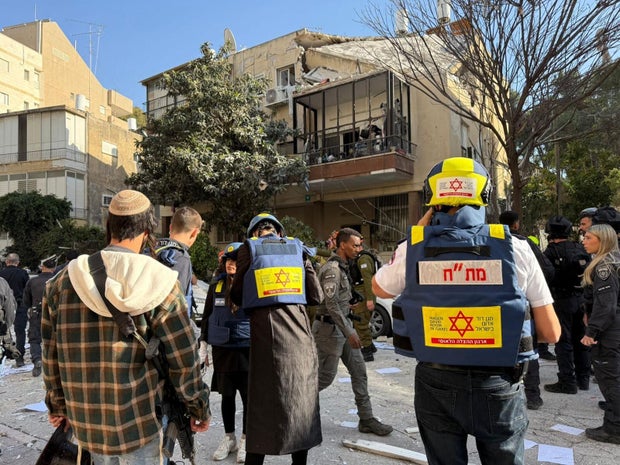
A photo shared by Israel's MDA emergency medical agency shows what it said was damage to a residential building in central Israel caused by an Iranian missile strike, March 3, 2026. Courtesy of Magen David Adom
Source
|