Trump renews threat to Iran's power plants as war sends oil prices soaring again
Posted by Temmy
Mon, March 30, 2026 3:46pm
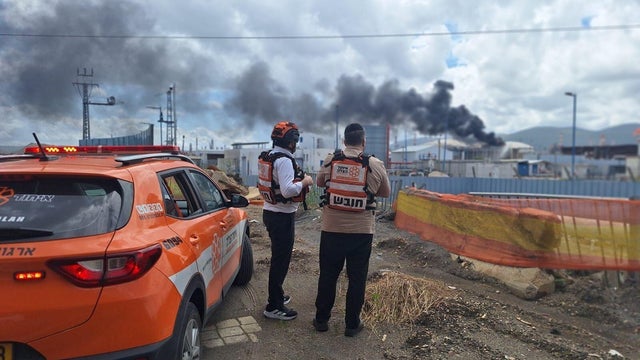
United Hatzalah paramedics observe smoke rising from near oil refineries in Haifa, northern Israel, after a salvo of missiles and drones launched by Iran and Hezbollah militants in Lebanon targeted northern Israel, March 30, 2026, amid ongoing U.S.-Israeli strikes on Iran. Handout/United Hatzalah
What to know about the Iran war today:
o President Trump continues suggesting a deal to end the Iran war could come soon, but as Tehran downplays the prospects of a diplomatic resolution and global oil prices soar again, he's also renewing his threat to strike Iranian power plants and other civilian infrastructure.
o The U.S. now has hundreds of special operations forces in the Middle East as President Trump threatens to "take the oil in Iran," with ground forces possibly being used to seize vital Iranian infrastructure. Iran has warned that it is waiting for the arrival of U.S. forces, "to set them on fire and punish their regional partners forever."
o Iran — along with its proxy forces Hezbollah in Lebanon and now the Houthis in Yemen — continues to launch missiles and drones at Israel and Persian Gulf states, with explosions reported Monday around Israeli oil infrastructure in the northern city of Haifa.
United Nations mission in Lebanon says peacekeeper killed amid Israeli assault on Hezbollah
The United Nations peacekeeping mission in Lebanon, UNIFIL, said Monday that one of its peacekeeping forces was killed by a projectile in the country's south amid Israel's escalating offensive against Iranian-backed Hezbollah.
"A peacekeeper was tragically killed last night when a projectile exploded in a UNIFIL position near Adchit Al Qusayr. Another was critically injured. No one should ever lose their life serving the cause of peace," UNIFIL said in a statement, adding that it did not "know the origin of the projectile" but that an investigation was underway "to determine all of the circumstances."
The U.N. agency added a call "on all actors to uphold their obligations under international law and to ensure the safety and security of U.N. personnel and property at all times, including by refraining from actions that may put peacekeepers in danger. Deliberate attacks on peacekeepers are grave violations of international humanitarian law and of Security Council Resolution 1701, and may amount to war crimes."
Israel has significantly ramped up its military operations in Lebanon against Hezbollah since the U.S. and Israel launched their joint war against Iran on Feb. 28, drawing retaliatory fire, primarily at northern Israel, from the U.S.- and Israeli-designated terrorist group.
The Israeli military says it takes all possible measures to avoid harming civilians, but it has ordered tens of thousands of people to evacuate their towns and villages in southern Lebanon as it expands ground operations and airstrikes.
According to Lebanese national health officials, more than 1,200 people have been killed by Israel's actions in the country over the last month, including at least 124 children.
At least six Israeli soldiers have been killed in Lebanon over the last month, including an American-born service member whose death was announced on Sunday. Two civilians have also killed by Hezbollah strikes on Israel amid the war.
Iranian parliament "reviewing" country's membership in international Nuclear Non-Proliferation Treaty
Iran's Foreign Ministry spokesman said Friday that the country was "reviewing" its membership in the international Nuclear Non-Proliferation Treaty, the pact that came into force in 1970 with the objective of stopping the spread of nuclear weapons.
The U.S., Russia and four other nations are acknowledged as nuclear weapons states in the treaty, while Iran is among the roughly 185 non-nuclear weapons possessing nations that also signed the pact, agreeing not to develop such weapons.
"Parliament has announced that it is reviewing the matter. The matter is also being discussed in public discourse. This is a big question, and the answer is not simple," Iranian foreign ministry spokesman Esmail Baqaei said Monday in televised remarks. "The logical question that our public asks is: What is the benefit of being a member of a treaty whose dominant international parties do not allow us to enjoy the rights and privileges it provides?"
Iran has for decades maintained a nuclear enrichment program that it insists is only for civilian purposes, as permitted under the NPT, but Israel and the Trump administration say it was working clandestinely at developing a nuclear weapons capacity, one of the reasons they say the current war was necessary. Mr. Trump has said recently that he will only agree to halt the war if Iran agrees to give up all enrichment, among other terms that Tehran has dismissed as excessive.
"If we cannot exercise the rights granted by it [NPT] and, on the contrary, are subjected to aggression and injustice — then what is the point of being a member? We remain a member of the treaty, and as long as we are, we are committed to the obligations it entails," Baqaei said Monday. "Fundamentally, the Islamic Republic of Iran has never sought nuclear weapons and does not intend to."
Hundreds of U.S. special forces, including Navy SEALs and Army Rangers, now in Middle East
Hundreds of U.S. special forces service members, including Navy SEALs and Army Rangers, are now in the Middle East, as well as thousands of Marines and Army paratroopers, sources familiar with the deployments told CBS News on Monday.
The sources said the deployments serve to give President Trump a range of options as Iran maintains its de facto blockade of the Strait of Hormuz, including operations that would target reopening the strait, taking oil from Iran's Kharg Island - a key location for its energy exports - or seizing Iran's stockpile of enriched uranium.
The deployment of special forces was first reported by the New York Times.
The U.S. military's Central Command has declined to comment on the deployments.
France says pro-Iran group suspected in thwarted bomb attack on Bank of America in Paris
French authorities are investigating a suspected link to Iran after thwarting a bomb attack outside a Bank of America building in Paris over the weekend, the interior minister said Monday.
The authorities suspect there could be a link to Iran due to similarities to other recent attempted attacks in Europe claimed by a shadowy pro-Iran group that only emerged online after the U.S. and Israel launched their current war on Iran, French Interior Minister Laurent Nuñez said.
Three suspects have since been arrested and the national anti-terrorism prosecutor's office opened an investigation into alleged terrorism-related offenses.
Authorities are making a "direct link" with Iran because the "modus operandi is in every respect similar to actions that have been carried out in the Netherlands and in Belgium," Nuñez said on French radio RTL on Monday morning.
In those cases there were claims of responsibility posted on the Telegram messaging app by a group using the name Harakat Ashab al-Yamin al-Islamia (the Islamic Movement of the Companions of the Righteous), saying it had acted in retaliation for U.S. actions in the Middle East.
The same group claimed responsibility for an arson attack last week in London that saw four ambulances belonging to a Jewish charity set ablaze.
Contacted by CBS News after the ambulance attack, an administrator for the group's online chat forum said it would "keep threatening U.S. and Israeli interests worldwide until we've avenged every child in Gaza, Iran, Lebanon, and the resistance nations."
Iran appears to let a few cargo ships, including 2 previously turned back, transit the Strait of Hormuz
At least two Chinese cargo ships that were blocked by Iran last week as they tried to transit the Strait of Hormuz managed to traverse the key waterway on Monday, according to tracking data from the MarineTraffic website.
Iran's Islamic Revolutionary Guard Corps naval forces appeared to make an example of the vessels, and one other, last week after President Trump suggested Tehran had given him the "present" of allowing eight vessels through the strait.
On Friday morning, data from MarineTraffic showed that two ultra-large container ships owned by China's biggest shipping company, COSCO, had made a sharp U-turn after apparently trying to sail past Iran's Larak Island, which analysts say Tehran has effectively turned into a toll booth to collect large fees from ships it grants permission to transit the strait.
In its statement on Friday, the IRGC said "the passage of any ship 'to and from' ports belonging to allies and supporters of the Zionist-American enemies, to any destination and via any corridor, is prohibited."
Both of the COSCO ships had transited the strait on Monday, coming close to Larak Island, according to the MarineTraffic data.
There was no immediate statement from Iran regarding the ships' passage.
Another bulk carrier, the Mac Hope, identifying itself as sailing under Chinese ownership and with a Chinese crew, also transited the strait on Monday, MarineTraffic data show. The vessel has been flagged as high-risk for transporting sanctioned cargo by the U.S. government since 2022.
During a Cabinet meeting on Thursday, Mr. Trump indicated that Iran was going to allow 10 oil tankers to pass through the Strait of Hormuz as a "present" to him. He didn't say which country or countries the oil was from or where it was heading.
On Saturday, the foreign minister of Pakistan, which has been acting as an intermediary between Iran and the Trump administration, said Tehran had agreed to allow 20 Pakistani-flagged vessels - two per day - to transit the Strait of Hormuz, calling it "a harbinger of peace" and a "welcome and constructive gesture."
Iranian state media said the same day, however, that the Islamic Republic's foreign minister Abbas Araghchi had, during a phone call with his Russian counterpart Sergey Lavrov, emphasized that the Strait of Hormuz remained closed to all vessels deemed linked to the U.S. and Israel.
Iran has said throughout the war that the strait remains open, but only to vessels it clears for transit - some of which it has charged fees of up to $2 million for passage, according to analysts.
American universities in Armenia and Mideast switch to in-person teaching after Iran threatens "retaliation"
The American University of Armenia said on Monday it was moving all classes online over Iranian threats to target U.S. universities in West Asia. Several U.S. universities have campuses scattered throughout the Middle East, including Texas A&M University in Qatar and New York University in the United Arab Emirates.
Iran threatened to target U.S. universities in the region after saying the ongoing U.S.-Israeli strikes had destroyed two Iranian universities.
"Due to the threat made by Iran to target American universities in West Asia and the Middle East, all AUA classes on Monday, March 30, will be held fully online," the university in Armenia said in a statement, adding that it had received no direct threats and stressing there was no cause for alarm, calling the move "a precautionary measure."
Iran's Revolutionary Guard issued a statement, carried by Iranian media on Sunday, saying: "If the U.S. government wants its universities in the region to be free from retaliation ... it must condemn the bombing of the universities in an official statement by 12 noon on Monday, March 30, Tehran time."
It advised "all employees, professors and students of American universities in the region and residents of their surrounding areas" to stay one kilometre (mile) away from campuses.
The American University of Beirut — one of the most prominent U.S. institutions in the region — said Sunday that it would also operate remotely over the next two days.
In Jordan, the American University of Madaba, about 22 miles southwest of capital Amman, said it was also holding online classes until Thursday for its 3,000 students.
Trump says U.S. negotiating with new "MORE REASONABLE" Iran regime, as he renews threat to attack power plants
President Trump said Monday morning that his administration was negotiating with "A NEW, AND MORE REASONABLE, REGIME" in Iran, reiterating his optimism that an agreement would soon be reached to end the war launched by the U.S. and Israel a month ago.
Iranian officials have repeatedly rejected claims that any direct talks are underway, and dismissed a proposal from the White House laying out 15 points for a ceasefire deal as "excessive and unreasonable," raising doubts that any common ground might be quickly found as Pakistan suggests a first U.S.-Iran meeting could take place in days.
In his Truth Social post on Monday, Mr. Trump did not give any more information about who in Tehran the U.S. was negotiating with, even indirectly, or why he believes there's been regime change despite no outward signs of any shift in policy by Tehran and continued attacks by the country on Israel and Gulf states.
"Great progress has been made," declared Mr. Trump, adding a warning that, "if for any reason a deal is not shortly reached, which it probably will be, and if the Hormuz Strait is not immediately 'Open for Business,' we will conclude our lovely 'stay' in Iran by blowing up and completely obliterating all of their Electric Generating Plants, Oil Wells and Kharg Island (and possibly all desalinization plants!), which we have purposefully not yet 'touched.'"
President Trump previously gave Iran an ultimatum, to open the Strait of Hormuz or face attacks on its power plants, but he then extended his deadline for the regime to do so twice, with it currently set at April 6.
Spain say its airspace off limits to U.S. planes for "actions related to the war in Iran"
Spain's leftist government has closed Spanish airspace to U.S. planes carrying out missions against Iran, in addition to denying Washington use of its bases, the defense minister said Monday.
"The bases are not authorized, and of course neither is the use of Spanish airspace for actions related to the war in Iran," Margarita Robles told journalists, confirming a report by the El Pais newspaper.
Spain's refusal to cooperate has "complicated" U.S. military operations by forcing bombers to change their routes and logistics on their way to the Middle East, El Pais reported.
The transit or landing of planes is allowed only in case of an emergency, the newspaper said.
Spanish Prime Minister Pedro Sanchez has emerged as the highest-profile Western leader to consistently oppose the war launched by the U.S. and Israel on Feb. 28, which has since engulfed the entire Middle East.
His stance has infuriated Spain's traditional NATO ally, with President Trump threatening to cut all U.S. trade ties. Spain had already sparked Mr. Trump's anger by refusing to agree to raise its domestic defense spending to 5%, as the White House has called on all of the alliance's member states to do.
Iran-backed Houthis entrance into war threatens another key shipping lane, and keeps oil prices soaring
Yemen's Iranian-backed Houthi rebels joined the war over the weekend, firing missiles at Israel for the first time since the U.S. and Israel launched their joint attacks on Iran a month earlier.
The attacks by the U.S.-designated terrorist group on Israel were limited, but they are being seen largely as a warning that it could get more deeply involved in the war.
The Houthis have previously attacked commercial ships in the Red Sea to disrupt the flow of oil, gas and other commodities through the Bab el-Mandeb strait. Along with the Strait of Hormuz, currently under a de-facto Iranian blockade, the two narrow waterways are the primary routes used by the Middle East's energy producers to get their products to the vast markets in Asia and beyond.
The Houthis warned more than a week ago that they could target shipping through the Bab el-Mandeb strait if Iran asked them to do so. They last attacked ships in the region in 2023, in retaliation for Israel's war against fellow-Iranian proxy Hamas in Gaza.
Retired Gen. Frank McKenzie, a former commander of the U.S. military's Central Command, told "Face the Nation with Margaret Brennan" on Sunday that he didn't believe the Houthis' entrance into the war would be a "game changer."
"They will have the ability to further stop slow traffic through the Bab el-Mandeb, going up into the Suez Canal," he acknowledged. "We have the ability to go down there and prevent that. It will require additional resources, but we have those resources, and we can certainly do it if that becomes necessary."
But given the inability of the U.S. to reopen the Strait of Hormuz thus far, despite a huge deployment of military personnel and assets in the region, Nomi Bar-Yaacov, fellow at the Geneva Centre for Security Policy, told The Associated Press on Monday that if the Houthis do follow through on their threat to the Bab el-Mandeb it could bring global energy markets to a "point where we have not been before."
"All eyes are on the mediation, but the oil crisis is, I think, at an unprecedented state," she said.
The concerns appeared to weigh heavily on energy markets Monday, with the price of international benchmark Brent around $115 per barrel in early trading.
Iran foreign ministry says no direct talks with U.S. yet, calls Trump admin's terms "excessive and unreasonable"
Iranian Foreign Ministry spokesman Esmail Baqaei was quoted by various Iranian state media outlets on Monday as saying the country had engaged in "no direct negotiations with the United States to date" and downplaying Pakistan's suggestion that such a dialogue was imminent.
"What has been raised are messages we received through intermediaries, indicating the U.S.' desire for talks," Baqaei said, according to various state-run Iranian news agencies.
"I don't know how many in the U.S. take claims of American diplomacy seriously! Unlike the other side, which constantly changes its position, our stance has always been clear. … We know exactly what framework we are considering. The messages conveyed to us have included excessive and unreasonable demands," said Baqaei, reiterating the Iranian regime's rejection of 15 points from the White House that were conveyed via intermediaries last week.
"The meetings held by Pakistan follow a framework that they themselves established and we did not participate in. It is good that regional countries are concerned about ending the war, but they should remain aware of which side started the conflict," Baqaei said.
"We must continue our work, engage in consultations, but our demands remain unchanged," he added.
Images show vital U.S. E-3 Sentry AWACS aircraft destroyed in Iranian strike on Saudi base that hurt 10 troops
The CBS News Confirmed team has verified images from the Prince Sultan Air Base in Saudi Arabia that show a U.S. Air Force E-3 Sentry AWACS surveillance aircraft destroyed on the tarmac after an Iranian missile and drone strike that left 10 service members wounded last week.
The E-3 Airborne Warning and Control System is a key piece of equipment for monitoring enemy activity and for mobile command and control that will, according to The Wall Street Journal, cost in the region of $700 million to replace.
Multiple U.S. officials told CBS News over the weekend that 10 U.S. service members were wounded in the Friday attack on the base, including two left with very serious injuries and eight in serious condition, which are different categories under the military's casualty classification system.
Thirteen U.S. service members have been killed since the U.S. and Israel launched the war with Iran, and more than 300 more have been wounded in action, most of whom have returned to duty, a U.S. Central Command spokesperson said Friday.
Global oil prices soar again as concern over war's impact hits Asian markets particularly hard
Asian share prices mostly dipped Monday, as worries continued about soaring oil prices and the potential for further escalation in the U.S. war with Iran, but stocks posted moderate gains in early trading in Europe and U.S. futures were also higher.
Wall Street finished last Friday with deep declines, for a fifth straight losing week, its longest such streak in nearly four years.
Worries have been great in Asia about the effective lack of access to the Strait of Hormuz because of the war in Iran, as the region relies significantly on oil from the region.
In energy trading, benchmark U.S. crude jumped $1.95 to $101.59 a barrel and Brent crude, the international standard, soared $3.41 to $115.98 a barrel. Before the war, Brent had been priced at about $70 to a barrel.
Investors are now bracing for the war to last for some time, which would likely set off inflation in global markets and could stunt Asia's economic growth.
"Although we do not expect the conflict to be protracted, we anticipate heightened volatility in the near term," said Xavier Lee, senior equity analyst at Morningstar Research.
Wave of Iranian missiles hits communities and an oil refinery in northern Israel
Israeli television channels reported at least one impact at an oil refinery in the northern city of Haifa on Monday, shortly after the military said it had detected new incoming missiles from Iran.
CBS News staff in Israel reported multiple impacts, which are often from debris of intercepted missiles or drones, across the north of the country amid a salvo of incoming fire from Iran and also Lebanon, where Iranian-backed Hezbollah is based.
Television network Channel 12 showed thick black smoke billowing into the sky from the site.
Emergency response agencies Magen David Adom and United Hetzolah were responding to multiple sites of reported impacts, but there were no immediate reports of injuries.
Trump says U.S. has already gotten regime change in Iran and deal could be reached "soon"
President Trump reiterated his stance on Sunday that the U.S. has already achieved regime change in Iran and a deal to end the war could be reached "soon."
Citing the number of Iranian leaders who have been killed in the month-long U.S.-Israeli war against Iran, Mr. Trump said the people now running Iran were "much more reasonable," despite ongoing Iranian missile and drone attacks across the region and the fact that the Islamic Republic's theocracy has signaled no public inclination to back down from the fight.
"We've had regime change," Mr. Trump told reporters on Air Force One. "We're dealing with different people than anybody's dealt with before. It's a whole different group of people. So I would consider that regime change."
Asked whether there could be a deal with Iran this week, Mr. Trump said, "I do see a deal in Iran. Could be soon."
Since the conflict began, Tehran has effectively shut down the Strait of Hormuz, through which about 20% of the world's crude oil typically flows, sending global oil prices soaring, but Mr. Trump said Sunday that relief was on the way in the form of concessions from Iran, starting with the imminent passage of more tankers through the waterway.
"They gave us, I think, out of a sign of respect, 20 boats of oil, big, big boats of oil going through the Hormuz Strait," he said, adding that the shipments would be "taking place starting tomorrow morning, over the next couple of days."
Source
|