India court allows plea seeking Hindu prayers at Gyanvapi Mosque
Posted by Temmy
Mon, September 12, 2022 2:25pm
Varanasi court rejects Muslim organisation's plea challenging request by some Hindu women to pray at 17th-century Gyanvapi Mosque.
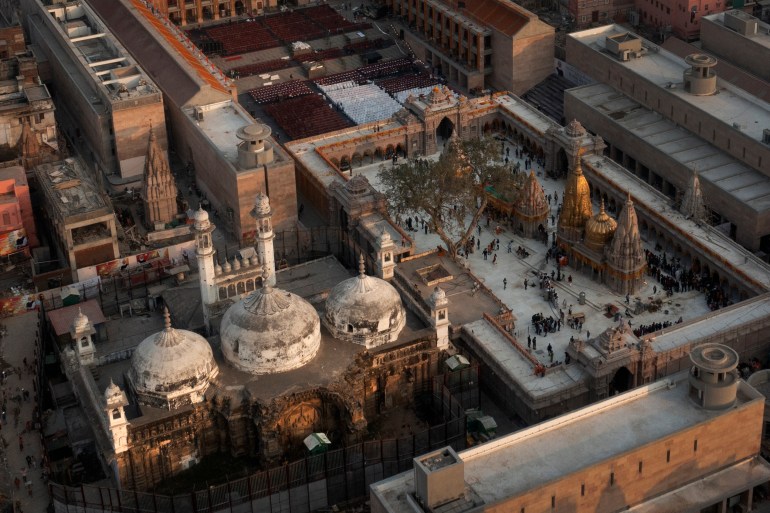
An aerial view of Gyanvapi Mosque, left, and Kashi Vishwanath temple on the banks of the river Ganges in Varanasi [File: Rajesh Kumar Singh/AP]
A court in India's northern town of Varanasi has rejected a Muslim organisation's plea challenging a request by some Hindu worshippers to hold daily prayers at a 17th-century mosque.
A group of Hindu women had moved the court earlier this year, seeking its permission to pray at a shrine inside the Gyanvapi Mosque.
The mosque believed to be built during the Mughal rule is adjacent to Varanasi's Kashi Vishwanath temple in the northern Uttar Pradesh state.
Rejecting the plea filed by Anjuman Intezamia Committee, the Muslim body that had challenged the women's petition, the court said the request by the women was "maintainable".
"The plaintiffs are only demanding right to worship The suits of the plaintiffs is limited and confined to right of worship as a civil right and fundamental right as well as customary and religious right," the court said.
The next hearing in the case will be held on September 22.
The Muslim body had argued the 1991 Places of Worship Act upholds the status of all religious structures as they stood on India's independence from British rule on August 15, 1947, thus protecting the status quo of religious structures.
Hindu groups claim the mosque was built in 1669 on the orders of Mughal emperor Aurangzeb after the demolition of a Hindu temple at the site. The petitioners say the complex still houses Hindu idols and motifs, a claim that has been contested by the mosque's authorities.
Syed Muhammad Yaseen, a representative of the mosque's management committee, said Muslims had been praying in the mosque for centuries. He said the committee will challenge the Varanasi court's order in a higher court in Allahabad city, renamed to Prayagraj in 2019.
"We follow the legal process and now we are thinking to move to Allahabad High Court. We will continue the legal battle," he told Al Jazeera.
Reports earlier this year claimed a court-mandated survey of the Gyanvapi Mosque - leaked to the media - discovered a "shivalinga", a phallic representation of the Hindu god Shiva, inside the mosque.
Muslims had already been banned from performing ablutions in the water tank where the alleged relic was found. The mosque's committee said the alleged stone shaft found in the reservoir was the base of a fountain.
The legal battle is the latest instance of a growing phenomenon in which right-wing Hindu groups petition courts demanding Muslim religious structures they claim to belong to Hindus.
The fear now is that the Gyanvapi Mosque will go the way of another Mughal-era mosque, the Babri Mosque in Ayodhya, which Hindu groups believe was built on the birthplace of their deity Ram.
The demolition of the Babri Mosque by a Hindu mob in 1992 sparked religious riots in which more than 2,000 people died, most of them Muslims.
Critics say such cases lead to fears over the status of religious places for India's Muslims, a minority community of 200 million people that has come under attack in recent years by Hindu nationalists who seek to turn officially secular India into an ethnic Hindu nation.
Varanasi is also the parliamentary seat of Indian Prime Minister Narendra Modi. A recent "draft constitution" released by right-wing Hindu groups last month proposed Varanasi as the capital of the "Hindu nation".
Khalid Rasheed, the chairman of the Islamic Centre of India, an organisation that works for the rights of Indian Muslims, told Al Jazeera that the Varanasi court entertaining the petition filed by five Hindu women raises many questions.
"The big question is that in the final judgement of the Ayodhya issue, the Supreme Court very clearly mentioned that the Places of Worship Act, 1991 will continue. It raised hopes that no issues related to the mosque-temple disputes will be raised," he said.
"But today the court has admitted the petition and rejected the grounds of the law, saying it will not apply in this case. It is a concerning development.
"We saw what the situation was during the Babri Mosque issue. We think no such issues should be raised and whatever was the status of any place of worship should be maintained."
Mosque-temple dispute in Badaun
Meanwhile, another court in Uttar Pradesh has said it will hear a petition filed by right-wing Hindu organisations, claiming an existing Jama Masjid Shamsi in Badaun city was built after demolishing a Hindu temple.
Akhil Bharat Hindu MahaSabha, a far-right Hindu group, along with some local residents last month filed the petition, claiming the mosque was built after razing the temple of Lord Neelkanth Mahadev.
The Badaun court fixed September 15 for hearing and issued notices to the mosque management, Uttar Pradesh Sunni Waqf Board, the state government and the union government.
Speaking to Anadolu Agency, the lawyer for Jama Masjid, Asrar Ahmad Siddiqui, said: "There is no proof available that it was a temple and the mosque was built after destroying it."
Siddiqui also claimed the mosque was built by Sultan Iltutmish, the ruler of Delhi, in 1222.
New Delhi-based lawyer Mehmood Pracha told Al Jazeera such court orders have the potential to create "more mischief rather than furthering the cause of justice and equity".
"The Places of Worship Act had to be enacted because of the Babri Mosque case, where in broad daylight a mosque was destroyed. The law was aimed to prevent such happenings in future and ensure status quo of religious places," he said.

A worker stands on a temple rooftop adjacent to the Gyanvapi Mosque in Varanasi [File: Pawan Kumar/Reuters]
Source
|