United Nations adopts high seas treaty, the first-ever pact to govern and protect international waters
Posted by Temmy
Mon, June 19, 2023 4:56pm
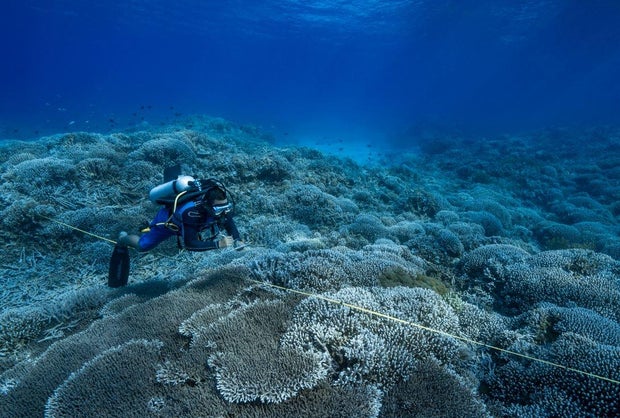
A marine biologist inspects signs of coral bleaching during a dive on Tubbataha reef, April 23, 2018, off the Philippines in the Sulu Sea. ALEXIS ROSENFELD/GETTY
The United Nations on Monday adopted the first-ever legally binding international treaty governing the high seas. Known as the Biodiversity Beyond National Jurisdiction Treaty (BBNJ), but widely referred to as the High Seas Treaty, the measure approved by the 193 U.N. member states imposes rules aimed at protecting the environment and heading off disputes over natural resources, shipping and other matters in waters beyond any country's national jurisdiction.
Until now, there has never been any international law governing the high seas, so many individuals and organizations hope the U.N.'s adoption of the measure will mark a clear turning point for vast stretches of the planet where conservation efforts have long struggled in a sort of wild west of exploration, overfishing, oil exploration and deep-sea mining.
"You have delivered," U.N. Secretary-General Antonio Guterres told the member nations Monday upon the treaty's adoption. "And you have done so at a critical time."
What's the point of a High Seas Treaty?
"To prevent a cascading of species extinctions, last year we universally agreed to the Global Biodiversity Framework's target of protecting 30% of the planet's land and sea by 2030," Peter Thomson, the U.N. Secretary-General's Special Envoy for the Oceans, told CBS News. "To reach that target, we'll have to establish Marine Protected Areas in the High Seas, and happily the BBNJ Treaty will give us the legal means to do that."
"Roughly two thirds of the Earth's oceans lie beyond national boundaries in an area known as the 'high seas' — yet only about 1% of that largely unexplored expanse has been protected. This year, nearly 200 nations finally agreed on the first treaty to protect the high seas," the Conservation International organization said.
The only treaty that came close previously was the U.N. Convention on the Law of the Sea, which came into force three decades ago. But that treaty regulated seas within country's territorial waters and exclusive economic zones, leaving nearly half the planet's surface and two-thirds of the ocean unregulated — particularly when it comes to protecting biodiversity. The new high seas treaty was agreed to under the authority of the previous Law of the Seas Treaty.
"The high seas are among the last truly wild places on earth," said Monica Medina, the Assistant Secretary of the U.S. Bureau of Oceans and International Environmental and Scientific Affairs, who was the Biden administration's chief negotiator and supporter of the treaty.
"It is often said that the ocean is too big to fail. That is simply not true," Medina said. "The ocean is more fragile than most people understand. It is also more essential. It provides the oxygen we breathe and food for tens of millions of people."
Nichola Clark, who works with the Pew Charitable Trusts' ocean governance project, told CBS News the treaty was "critical for our climate, as the world's oceans play "an important role in regulating our climate - absorbing carbon dioxide and excess heat from the atmosphere, regulating temperatures, and driving our global weather patterns."
So, what's in the treaty? Here are the key points:
MPAs: The treaty establishes a framework for "Marine Protected Areas" — beyond the ones already within national territorial waters — to counter biodiversity loss and degradation of ecosystems of the ocean caused by the impact of climate change, including warming and acidification of oceans, as well as plastics, pollutants and overfishing.
It establishes standards and guidelines to determine the environmental impacts of high seas activities, including their impact on marine life and ecosystems. It requires signatory countries to present an assessment of pollution or other impacts of their proposed activities on the high seas, such as deep-sea mining.
The treaty creates a Conference of Parties (COP) to monitor and enforce compliance with the treaty's terms, which will include a scientific advisory board.
It creates a mechanism for the transfer of marine technology to developing countries to ensure equitable sharing of benefits and resources from the high seas, including materials that could prove ground-breaking in medical and nutrition science.
Final hurdle: National ratifications
There is a final hurdle — or 60, actually — that the new treaty must still clear: It will only go into effect 120 days after it is ratified by at least 60 U.N. member nations individually. In the U.S., that means Senate approval.
Clark, of the Pew Charitable Trusts, told CBS News the hope was that the requisite 60 ratifications would be in-hand by the next U.N. Ocean Conference, set to convene in the summer of 2025.
"As with all treaties, ratification is the key to bringing it into force, and only then can we implement the benefits accruing. All parties should work towards this being achieved by the time of the next UN Ocean Conference, June 2025, in Nice, France," the U.N.'s Thomson told CBS News.
But in a sign of the work still to come, Russia's delegate Sergey Leonidchenko on Monday made it clear that his country, "distances itself from the consensus on the text of the agreement prepared by the conference."
While Moscow did not seek to block adoption of the treaty by the U.N., his remarks made it clear that Russia could not yet be counted on for one of the 60 required ratifications, calling the international treaty as written, "unacceptable."
Source
|