U.S. has welcomed more than 500,000 migrants as part of historic expansion of legal immigration under Biden
Posted by Temmy
Tue, July 18, 2023 3:03pm
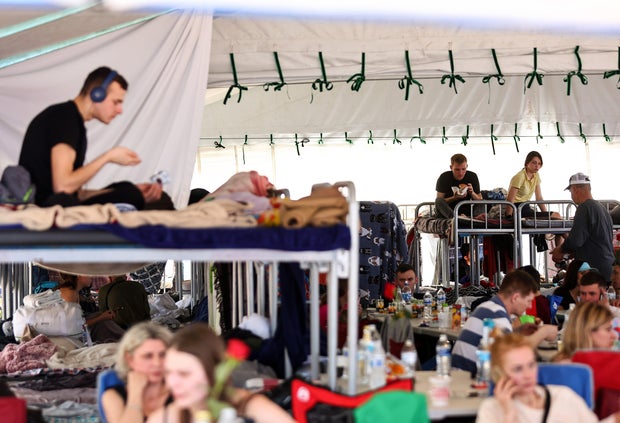
Ukrainians who are seeking asylum in the United States gather in a city government shelter for Ukrainians on April 7, 2022, in Tijuana, Mexico. GETTY IMAGES
The Biden administration has welcomed over half a million migrants under programs designed to reduce illegal border entries or offer a safe haven to refugees, using a 1950s law to launch the largest expansion of legal immigration in modern U.S. history, unpublished government data obtained by CBS News show.
In less than two years, the administration has allowed at least 541,000 migrants to enter the U.S. through the immigration parole authority, which gives federal officials the power to authorize the entry of foreigners who lack visas, according to internal government statistics, court records and public reports.
The unprecedented use of the parole authority has allowed officials to divert migration away from the southern border by offering would-be migrants a legal and safe alternative to journeying to the U.S. with the help of smugglers and entering the country unlawfully. It has also given the administration a faster way to resettle refugees as it attempts to rebuild a resettlement system gutted by drastic Trump-era cuts.
Officials have invoked the parole authority to welcome roughly 168,400 Latin American and Caribbean migrants with U.S. sponsors; 141,200 Ukrainian refugees sponsored by Americans; 133,000 asylum-seekers who waited for an appointment in Mexico; 77,000 Afghan evacuees; and 22,000 Ukrainians processed at the U.S. southern border, the data show.
Taken together, the immigration parole programs created by the Biden administration amount to the most significant expansion of legal immigration in three decades. And to the dismay of Republican critics, the administration has done so unilaterally, without explicit consent from Congress, which has not expanded legal immigration levels since 1990 amid decades of partisan gridlock.
"Unprecedented"
To come live and work in the U.S. legally, immigrants generally must have a visa or approved refugee status. But a law dating back to 1952 allows officials to use the parole authority to admit those who don't have visas if doing so furthers an "urgent humanitarian" cause or "significant public benefit." While it does not make migrants eligible for permanent status or citizenship, parole gives them the ability to live and work in the U.S. legally, typically for one- or two-year increments that can be renewed.
Doris Meissner, a top U.S. immigration official during the Reagan and Clinton administrations, said there's precedent for using parole to resettle refugees. During the Cold War, Republican and Democratic administrations paroled hundreds of thousands of refugees fleeing communism in Cuba, Eastern Europe and Southeast Asia. But Meissner said the Biden administration's use of parole is historic.
"At this scale, in this time period, it is unprecedented," said Meissner, who led the now-defunct Immigration and Naturalization Service from 1993 to 2000.
León RodrÃguez, who served as director of U.S. Citizenship and Immigration Services during President Barack Obama's second term, said the expansive use of parole has become a "necessity" because the Biden administration has recognized it cannot address migration flows through deterrence alone.
"It's fair to say that the pressures are much greater now, which is why the numerical scope of these parole programs is probably the largest we've seen, certainly in a long time," RodrÃguez said.
How the Biden administration has used parole
The Biden administration's first large-scale use of parole occurred in the summer of 2021, when it invoked the law to resettle tens of thousands of Afghans after a massive airlift from Taliban-controlled Afghanistan.
Then, in early 2022, the administration used the parole authority to process thousands of Ukrainians who had flown to the U.S.-Mexico border in the early days of Russia's invasion of Ukraine. To discourage future Ukrainian arrivals along the southern border, officials created a program, known as Uniting for Ukraine, to allow Ukrainians to fly directly to the U.S. to receive parole if they have American sponsors.
In October 2022, the administration created another sponsorship-based parole program, based on the Ukrainian model, for Venezuelan migrants, who were crossing the U.S.-Mexico border in record numbers. That program was expanded in January to include migrants from Cuba, Haiti and Nicaragua and deter illegal border crossings by citizens of those crisis-stricken countries.
That same month, the U.S. started allowing migrants in Mexico to use a mobile app, known as CBP One, to request an opportunity to enter the country at a legal port of entry. Those allowed into the U.S. under the process are generally paroled for one or two years and given a hearing in immigration court, where they can request asylum, government officials and lawyers confirmed.
The Biden administration has also used parole on a smaller scale to welcome deported U.S. military veterans, migrant families separated under the Trump administration, at-risk Central American minors with family members in the U.S. and Cubans and Haitians with American relatives.
The number of migrants paroled into the U.S. is expected to increase even further. The program powered by the CBP One app currently allows up to 529,250 migrants to be processed each year, while the sponsorship program for Cubans, Haitians, Nicaraguans and Venezuelans has an annual ceiling of 360,000 arrivals. The Uniting for Ukraine policy has no numerical cap.
Moreover, the Biden administration is also operationalizing another program that will allow migrants from Colombia, El Salvador, Guatemala and Honduras to enter the U.S. under the parole authority if the government has approved visa petitions filed by their U.S. citizen or resident relatives.
A legal dispute
The Biden administration has said the use of parole has allowed the U.S. to resettle at-risk refugees, reunite families and relieve pressure at the U.S.-Mexico border. Officials, for example, have credited the CBP One app and program for Cubans, Haitians, Nicaraguans and Venezuelans — as well as stricter asylum rules — for a dramatic drop in illegal crossings along the southern border in recent weeks.
But the widespread use of parole has garnered strong criticism from Republican lawmakers and state officials, who have accused the Biden administration of abusing the authority and circumventing the limits Congress placed on work and immigrant visas.
In an ongoing lawsuit challenging the policy for Cubans, Haitians, Nicaraguans and Venezuelans with U.S. sponsors, Republican-led states called the initiative an "illegal program" that imposes a financial burden on American communities due to social and medical services costs.
"The Department of Homeland Security, under the false pretense of preventing aliens from unlawfully crossing the border between the ports of entry, has effectively created a new visa program — without the formalities of legislation from Congress," the states argued.
Senior DHS officials said the administration's use of parole is lawful because, despite the large-scale nature of the programs, immigration officials still make individual determinations as to whether migrants should receive parole, and some applicants are denied entry. All parolees under security vetting, officials said.
"There are case-by-case adjudications happening. And that is why we very strongly believe that this is well within our statutory authorities and is a use of parole that's been consistent with how parole has been used in the past," an official said under condition of anonymity to discuss these matters.
For the past decades, Democratic and Republican administrations have created parole programs; though they were much smaller in scope, like processes for military families and Cuban doctors set up under President George W. Bush. The Trump administration tried to severely curtail the use of parole, but still kept some programs in place.
The DHS officials stressed that the administration believes its parole processes should not be grouped together, since they arose from distinct circumstances. The officials also noted that over the same period when more than half a million people were paroled, the U.S. deported or expelled migrants over 3 million times, mostly under the now-expired pandemic border measure known as Title 42.
"More individuals have been removed or expelled than paroled in the last two years, and the conflation of very different parole processes that serve very different purposes is misleading and wrong," DHS spokesperson Naree Ketudat said in a statement.
The programs for Afghans and Ukrainians were created in response to emergency situations overseas, the DHS officials said. The parole process for Cubans, Haitians, Nicaraguans and Venezuelans, they added, was set up to discourage unlawful migration and as part of a deal in which Mexico agreed to accept migrants from these countries who enter the U.S. illegally. Unlike those programs, migrants processed under the CBP One process are placed in deportation proceedings in addition to being paroled, the officials noted.
While the DHS officials said they view the programs as "very different" forms of parole, one official acknowledged that "technically it's the same underlying authority that's allowing these folks to come."
"An indeterminate situation"
While advocates for migrants have generally applauded the administration's use of parole, they have expressed concern about hundreds of thousands of migrants becoming stuck in legal limbo, without a path to permanent legal status. A Republican administration could also terminate their parole grants.
"It is an indeterminate situation for hundreds of thousands of people. But at the same time, it is safety and protection for the moment," said Meissner, the former top immigration official and now a senior fellow at the Migration Policy Institute, a nonpartisan think tank.
During the Cold War, Congress passed several laws to give those paroled into the country permanent residency. But the odds of the current deeply divided Congress doing so again are slim, even for populations like Afghan evacuees, who have enjoyed bipartisan support.
The senior DHS officials said they expect migrants to leave the U.S. once their parole expires if they have not gained permanent status by applying for programs like asylum or visas for relatives of Americans.
"If they, at the end of the two years, have not found a lawful pathway in the U.S., our expectation is that we will be seeking to remove those individuals," one official said.
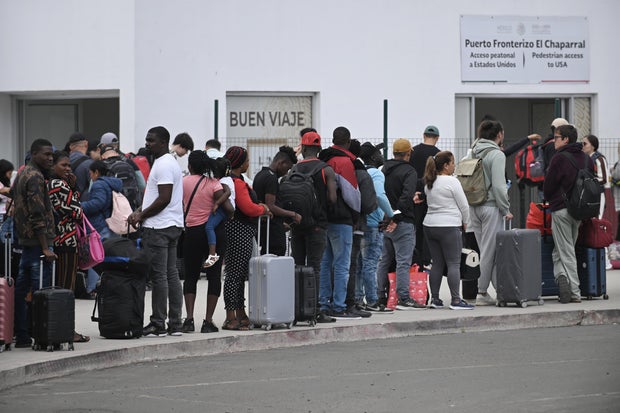
Migrants with CBP One app interviews are allowed to enter the U.S. at the Chaparral pedestrian border on May 16, 2023, in Tijuana, Mexico. CARLOS A. MORENO/ANADOLU AGENCY VIA GETTY IMAGES
Source
|