Flying snake, pit viper among rare and new species discovered in cave in Cambodia
Posted by Temmy
Wed, March 25, 2026 12:44pm
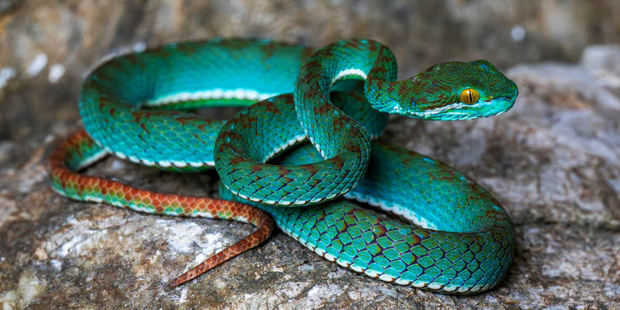
A new species of pit viper. Phyroum Chourn / Fauna & Flora
Researchers have discovered multiple rare and new species in previously unexplored caves in Cambodia, including a flying snake and a florescent-turquoise pit viper.
Those creatures were found during a multi-year biodiversity study that surveyed more than 60 limestone caves in western Cambodia's Battambang province. The project took researchers to 10 different hills across the region known for its karsts, which are limestone cliffs filled with hidden caves and ecosystems, according to a report by Fauna & Flora Cambodia, an organization that led the study alongside the country's ministry of environment.
Cambodia's karst formations have historically been some of the least-studied of their kind, the organization said. It described the karsts as "small islands of habitat, each with its own collection of plants and animals," which became isolated from each other over time, as human activity sprung up around them.
"Surrounded by a sea of inhospitable, human-made landscapes, many of these creatures are, in effect, trapped," said Fauna & Flora. "Today, each of those miniature karst havens contains species that are found nowhere else in the world."
From November 2023 to July 2025, teams of experts ventured into the caves through narrow gaps in the limestone, weaving their way through dark tunnels that, often, were only large enough for them to crawl on hands and knees. Photos and video show the explorers squeezing through jagged crevices deep inside the karsts, using flashlights to guide them further along an otherwise pitch-black maze of rocky burrows. In some footage, bats fly just overhead.
New and familiar species
Past the web of tight spaces sat an untouched series of caves, where researchers uncovered numerous rare species in addition to others never seen before. In addition to the pit viper, they found what the report dubbed "cryptically camouflaged leaf-toed geckos" and vividly colored millipedes, which are likely quite poisonous.
The pit viper is still being formally characterized, but the report called it a "spectacular new species" with recognizable triangular heads, which are "highly venomous" and "track down their warm-blooded prey using the heat-sensitive pits behind their nostrils."
"Each of these isolated karst areas act as their own little laboratory — where nature is performing the same experiment over and over and over independently," said Lee Grismer, a biology professor at California's La Sierra University who worked on the biodiversity study, in a statement. Grismer said the result of such quarantined conditions is the development of species that exist only there, at times inside of just a single cave.
A range of other species, some rare, some not, were recorded inside the caves, too.
Researchers found many reptiles, including a reticulated python, the world's longest snake, and a bright green flying snake. Also known as the ornate flying snake or golden tree snake, it is native to South and Southeast Asia.
They also encountered spot-legged tree frogs and technicolored agamid lizards, which are commonly seen throughout the area, according to the report.
Conservation mission
In addition to learning more about the karsts' mysterious ecosystems, the biodiversity study aimed to advocate for their conservation. The ecosystems are among the least protected in the world, said Fauna & Flora. The organization noted that karst habitats "are threatened by poorly planned quarrying for cement, unmanaged tourism, wildfires, logging and hunting," and just 1% are legally safeguarded globally.
"Every time you destroy one of these hills, species might be at risk of extinction," said Sothearen Thi, a biodiversity coordinator who also worked on the study, in a statement. "Many species may vanish before they can be discovered."
Source
|