A look at Titanic wreck ocean depth and water pressure — and how they compare to the deep sea as a whole
Posted by Temmy
Mon, June 26, 2023 1:50pm
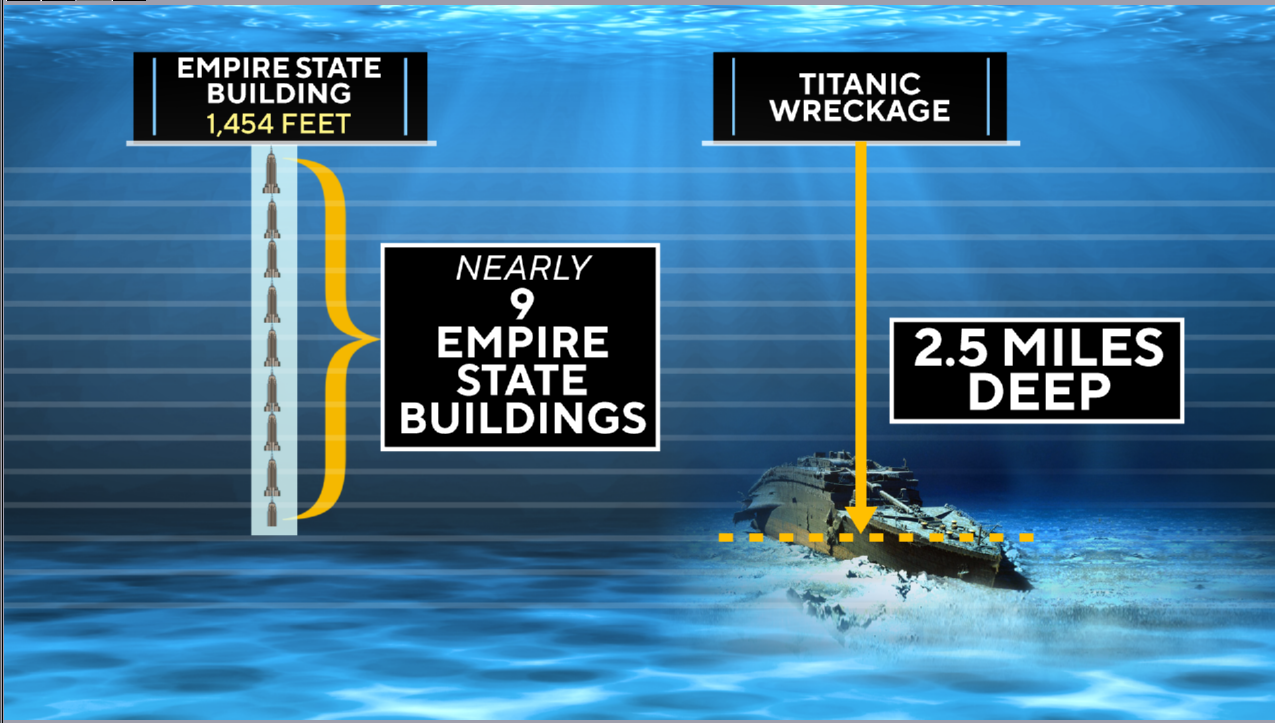
The Titanic wreckage is about 12,500 feet deep in the North Atlantic — that's as deep as about nine Empire State Buildings stacked on top of each other. CBS NEWS
Debris from the Titan, the submersible that disappeared on an expedition to the wreckage of the Titanic, was found nearby the ship, which sits on the bottom of the Atlantic Ocean. The Titanic is a whopping 2 and a half miles beneath the surface — far too deep for a human to survive the pressure if not in an equipped vessel. Still, there are other parts of the ocean that are even deeper, and many parts yet to be explored.
Ocean depths
About 71% of the Earth is covered in water and the average depth is 12,080 feet — which is nearly as deep as Mount Fuji is tall, according to Woods Hole Oceanographic Institute. Only 5% of the ocean has been explored.
The depths of the ocean are broken into zones. The euphotic zone, or "sunlight zone," extends down to about 656 feet and is where sunlight can penetrate, so plants like phytoplankton and macro algae can grow, according to NOAA.
The Yellow Sea, which lies between China and Korea, is entirely in this zone at about 499 feet deep. The Statue of Liberty, at 305 feet, would become fully submerged in this zone.
Between 656 and 3,280 feet is the dysphotic zone, known as the "twilight zone," where the amount of sunlight decreases drastically as the depth increases.
The Baltic and Red Seas reach this depth. The Eiffel Tower, which stands at about 1,083 feet tall, and the Burj Khalifa, the world's tallest skyscraper at 2,716.5 feet tall, would become submerged in this zone.
At about 3,280 feet, you hit the aphotic zone, where no light can reach. Within this zone, the "midnight zone" extends to about 13,000 feet and the abyss extends to about 19,685 feet. Anything deeper than this is the hadal zone.
The Titanic wreckage, which is about 12,500 feet deep in the North Atlantic, is in the midnight zone. That's as deep as about nine Empire State Buildings stacked on top of each other.
The Mediterranean Sea, Caribbean Sea, Red Sea and all the world's oceans reach what's known as the aphotic zone, where the only light is generated by organisms. There is less food and less life down there, but sometimes dead animals like whales or sharks can sink this deep.
The deepest part of the world's oceans, the Mariana Trench, is about 36,070 feet, nearly seven miles deep, in the hadal zone, according to NOAA. The trench is in the Pacific Ocean, off the coast of Japan, and has been explored before.
Hamish Harding, who died on the Titan submersible traveling to the Titanic wreckage, was one of the handful of people who have explored the Mariana Trench. In 2021, he traveled 2.5 miles along the ocean floor and set a record for the longest distance traveled at the deepest part of the ocean by a crewed vessel.
The pressure in the trench is 8 tons per square inch, but still, life exists, NOAA says. Single-celled organisms called foraminifera were discovered in the Challenger Deep, the deepest point in the trench, in 2005.
The deepest a fish has ever been spotted was 27,460 feet deep in the Puerto Rico Trench, in between the Caribbean Sea and Atlantic Ocean.
Ocean pressure
The pressure at sea level is about 14.7 pounds per square inch, which you can't feel, according to the National Ocean Service, which is part of NOAA. But as you dive deeper, the hydrostatic pressure, or force of a liquid on an object, increases and your eardrums will start to feel the change. Every 33 feet, the pressure increases one atmosphere, which is the unit of measure for barometric pressure.
Some animals, like whales, can survive extreme depths and pressures. The deepest a human has ever reached scuba diving is about 1,090 feet, achieved by Ahmed Gabr in 2014 after years of training. At that depth, the pressure is about 470 pounds per square inch.
The recommended maximum depth for conventional scuba divers is 130 feet, according to NOAA.
Few vessels are equipped to withstand the pressure of extreme depths. American explorer Victor Vescovo used a $48 million submersible when he and Harding explored the Challenger Deep.
According to a former employee of OceanGate Expeditions, which built the Titan, the submersible was only equipped to withstand the pressure of 1,300 meters, or about 4,265 feet. That employee, submersible pilot David Lochridge, who was fired by OceanGate, filed a lawsuit against the company in 2018, alleging the Titan would travel about 13,000 feet deep, despite the fact that depth had never been achieved by a sub with this type of carbon fiber hull.
The Titanic submersible
The Titan launched from Newfoundland, Canada, on Sunday, with five people on board journeying to the Titanic wreckage, which is located about 350 miles from Newfoundland. About an hour and 45 minutes into the Titan's dive, it lost contact with the crew on the Polar Prince research ship above.
After a desperate and days-long search, debris from the submersible was found about 1,600 feet from the Titanic wreckage. It was determined that the sub imploded just hours into its dive, killing all five passengers on board, officials said.
Stefano Brizzolara, co-director of the Virginia Tech Center for Marine Autonomy and Robotics, says failure of the sub's pressure hull probably caused the implosion. "You must consider that at 4,000 meters depths, the pressure is 400 times what we experience at sea level," he told CBS News. That's about 13,000 feet, or nearly 2.5 miles.
Inflated car tires have about 2 atmospheres of pressure, he said, so the pressure at this depth is 200 times that. At this depth, there is also no light, and if a strong light is brought down, it can penetrate only about 65 feet, so sonar must be used to navigate, Brizzolara said.
Search and rescue crews were using ROVs, or remotely operated vehicles, to search for the Titan. These vessels are equipped to travel the 13,000 feet down to the Titanic and withstand the 6,000 pounds per square inch of pressure. An ROV from a Canadian vessel ended up locating the Titan debris.
Source
|