Crime-solving techniques may have solved centuries-old art mystery
Posted by Temmy
Fri, December 06, 2024 1:10pm
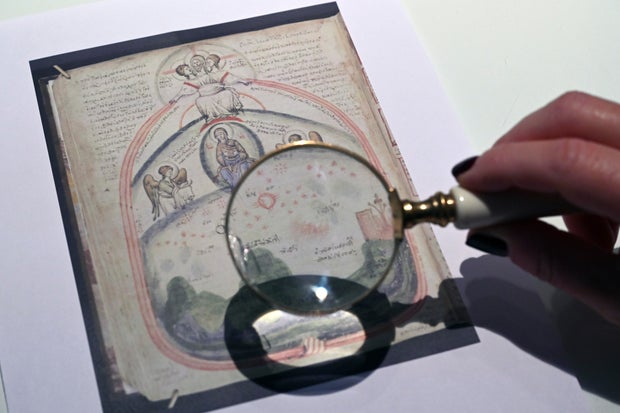
Christina Sotirakoglou a handwriting expert, observes Byzantine paintings based on photographs prints, at her office, in Thessaloniki, northern Greece, Saturday, Nov. 30, 2024. Giannis Papanikos / AP
Crime-solving techniques applied to a medieval illuminated manuscript in Paris may have solved a centuries-old puzzle - the true identity of a leading Byzantine painter who injected humanity into the rigid sanctity of Orthodox religious art.
A contemporary of Giotto, considered the father of Western painting, the artist conventionally known as Manuel Panselinos was equally influential in a totally different tradition that's largely overlooked in the West.
But nothing is known of his life, and scholars now believe Panselinos was just a nickname that eventually supplanted the real name of the man for whom it was coined - likely Ioannis Astrapas, from the northern Greek city of Thessaloniki.
The art of Byzantium, that decorates churches across Greece, Serbia and other Orthodox countries, stands out for the stark formalism of its elongated, glowering saints, quasi-cubist mountains and doe-eyed Madonnas.
Work attributed to Panselinos, from the late 13th and early 14th centuries, is considered the finest produced in an empire that straddled Europe and Asia and endured from the fall of Rome until the capture of the imperial capital Constantinople by the Ottoman Turks in 1453.
Art historians had long suspected that the name - Greek for "full moon" - could have originated as a nickname for some member of the so-called Macedonian School of painting, based in Thessaloniki.
Recent research by a Greek monk and linguistics scholar linked "Panselinos" with Macedonian School painter Astrapas. Now court handwriting expert Christina Sotirakoglou has matched lettering on a manuscript tentatively attributed to Astrapas with characters on a church painting in northern Greece, long seen as Panselinos' best work.
Father Cosmas Simonopetritis, a former senior administrator in Mount Athos, the semiautonomous monastic community where the Protato church stands, says Sotirakoglou's and his own research "clearly prove" Panselinos' real identity.
"Panselinos was a real person, and (the name) was just the nickname by which Ioannis Astrapas became known," he told The Associated Press.
Constantinos Vafiadis, a professor of Byzantine art in Athens who was not involved in the studies, said he found merit in the nickname theory and Astrapas link, even though it appeared more than one painter had undertaken the Protato project.
"I agree with attributing part of the paintings to Ioannis Astrapas," he said. "But again there remains much ground for future research into that person, because other Mount Athos monuments from the same period have not yet been sufficiently published."
"Panselinos" - a role model for generations of painters - and his contemporaries are associated with a renaissance of kinds in Orthodox art that revived forms and techniques inherited from antiquity. Facial expressions acquired a deeper humanity, and greater attention was paid to proportion and depth of field in composition.
Father Cosmas said Astrapas was an "extremely gifted painter ... with vast knowledge who harmonically combined the ancient, classical world with Orthodox Byzantine spirituality."
"And that ... makes his work unique worldwide," he added.
Artists' signatures were not common at the time, although some survive from members of the Astrapas family. There are none by "Panselinos."
The trail started with earlier research linking Astrapas with the artist and scholar who wrote and illustrated Marcian Codex GR 516, an early 14th century Greek handwritten text treating subjects from astronomy to music theory. Among the painted illustrations was a full moon.
"For me ... that was the main proof," Father Cosmas said.
With a name found for the hand that produced the manuscript, the next step was to check its style against writing on the Protato painting, traditionally linked with "Panselinos."
"Mrs. Sotirakoglou, who is a handwriting expert, filled in that blank," Father Cosmas said.
There was one problem: Women have for more than 1,000 years been banned from entering Mount Athos.
"I was forced to study the Protato paintings based on photographs," Sotirakoglou, who works as a court consultant on identifying or authenticating handwriting in criminal cases, told the AP.
"(The work) was very difficult, because the writing on the wall paintings is in capital letters, and the painters subdued their personal handwriting to conform" with the traditional format, she said - rather like anonymous letter-writers' attempts to disguise their true style. "The Marcian codex is written in very small lower-case letters."
The first clue came from the Greek letter Phi, the English F.
"It's a Phi that stands out, and is similar" in both the manuscript and the Protato painting, she said. "Matches also followed with other letters, T, with its proportions, which is bigger, covering the other letters and is topped with a curve, the proportions of the K."
"But when the Phi was revealed, the code of the writing was broken and the job became much easier," she added.
Father Cosmas said that during his administrative duties on Mount Athos he attended services at the Protato church on a daily basis.
"That's where my desire was born ... to explore the mystery around the name and the identity of Panselinos," he said, adding that he thinks the artist "has now acquired his true identity."
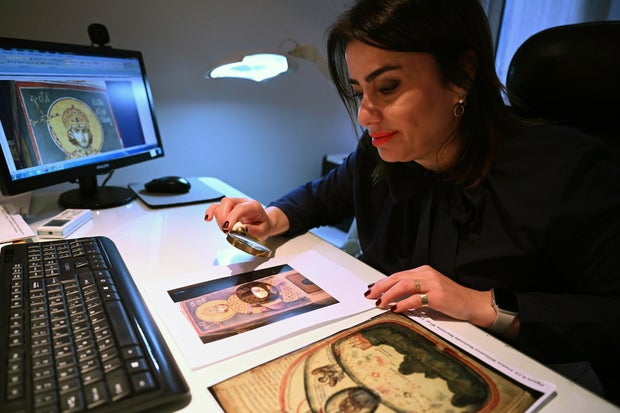
Christina Sotirakoglou a handwriting expert, observes Byzantine paintings based on photographs prints, at her office, in Thessaloniki, northern Greece, Saturday, Nov. 30, 2024. Giannis Papanikos / AP
Source
|