Researchers find 3-million-year-old tools in Kenya, showing development of human ancestors
Posted by Temmy
Sat, January 04, 2025 10:31pm
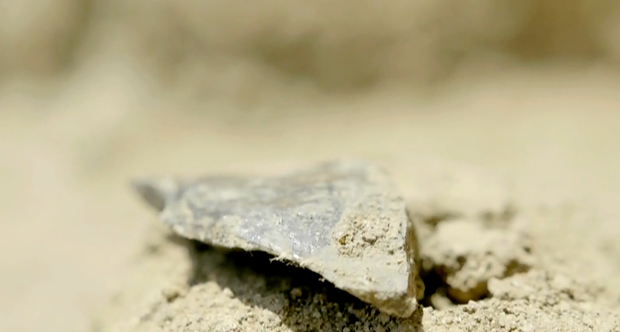
A prehistoric flake, or small knife. CBS Saturday Morning
On a lakeside peninsula in Eastern Africa, archaeologists have found clues about a society that lived there over 3 million years ago.
The Homa Peninsula, in Kenya, is part of the East African Rift Valley, a part of the world often called "the cradle of humankind." So many of the oldest clues about humanity's earliest days have been preserved under the valley's fertile, human soil, including the remains of "Lucy," an ancient human relative who lived more than 3 million years ago.
Tom Plummer and his team are the latest to make discoveries in the area, working at a site on the peninsula called Nyanga. The team found flakes, or little knives, at the dig site. The blades are believed to be some of the first tools ever used on Earth — and even after more than 3 million years, they still have a sharp edge.
Plummer, an archaeologist at the City University of New York, said the blades were made by hammering one stone against each other. The knives would have been used to peel and cut fruits and vegetables, and to cut the flesh off prey like hippos, Plummer said. The meat would then be pounded between stones to tenderize it. The knife and stones are known as the Oldowan tool kit, and likely set the stage for further technology advancement down the line.
"I think the Oldowan technology is probably the most important technological innovation that ever happened in human history," Plummer told "CBS Saturday Morning."
"It allowed (the pre-human ancestors) to access a whole array of foods that they would never have had access to before."
Plummer said that new diet would have fueled body and brain growth, starting a "feedback loop" that created more sophisticated beings who "start doing more with technology." An similar, even older cutting tool was also found in Kenya, but that technology apparently died out, so Plummer believes this tool is the one that can be credited for those developments.
"I think that's all starting with the Oldowan," Plummer said.
Who made the tools is another surprise. Along with the tools, Plummer's team found the tooth of a paranthropus, an early hominin that is not a direct ancestor of humans. That suggests that the first tool making is not a human legacy, but an idea humanity's ancestors copied, then used to dominate other hominins, who ultimately died out.
Rick Potts, the director of the Smithsonian's human origins program and the leader of research on the peninsula, said that discovery can help frame humans' existence on the planet.
"We are the last biped standing, as I call it," Potts said. "All of those other ways of life became extinct. And so that gives us a lot to think about, and it draws attention to the fragility of life, even in our own journey through time."
Searching for pre-human history
The search for these early artifacts has the look and intrigue of an "Indiana Jones" film. Finding the splintered rocks that showed evidence of being used as tools was one thing, but the archaeology team then had to find the cut marks on animal bones that confirmed how the knives were being used.
Blasto Onyango, a local archaeological legend who helped uncover the Turkana Boy, the most complete early hominin skeleton ever discovered, said that his impressive find took "four or five years" to find. As the time passed, he and other archaeologists found "different parts of the" skeleton, working slowly but surely to uncover the remains of a young boy who lived over one and a half million years ago.
Paleontology researcher Rose Nyaboke said that kind of painstaking, slow research is what makes up the day-to-day work of an archaeology dig. Sometimes, she and other researchers find small pieces of bone, but have to leave those fragments where they were found.
"We don't just pick anything. It has to have a paleontological meaning," Nyaboke explained. "We tell it 'Sorry. We can't pick you today.'"
The bones that matter are ones that can lend context to the area, such as pig's teeth. Pigs evolved so quickly their skeletons help date the surrounding area. The site is too old for carbon dating, and the ancient volcanic ash that has preserved the artifacts makes other dating methods too hard to use. The area had actually been mostly abandoned by researchers after artifacts from the Homa Peninsula led to inaccurate claims about human origins. Despite all that, Potts started digging on the peninsula nearly 40 years ago.
"We found a place that's difficult to date, but we didn't leave, because science takes persistence," Potts said.
That persistence has been rewarded with discoveries like Plummer's. New technologies have made the sites easier to date, and new discoveries across eastern Africa have refined researchers' understanding of human roots. Researchers knew that modern homo sapiens emerged in Africa about 300,000 years ago, but it wasn't until recently that they understood that their hominin ancestors began walking on two legs at least 6 million years ago.
"Some of the things that we thought occurred in a very short period of time, within the last one million years, are now stretched out over a 6 million year period," Potts said. "That includes tool making."

A model of a hominin. CBS Saturday Morning
Source
|