World's largest iceberg — on collision course with remote penguin island — runs aground
Posted by Temmy
Wed, March 05, 2025 1:52pm
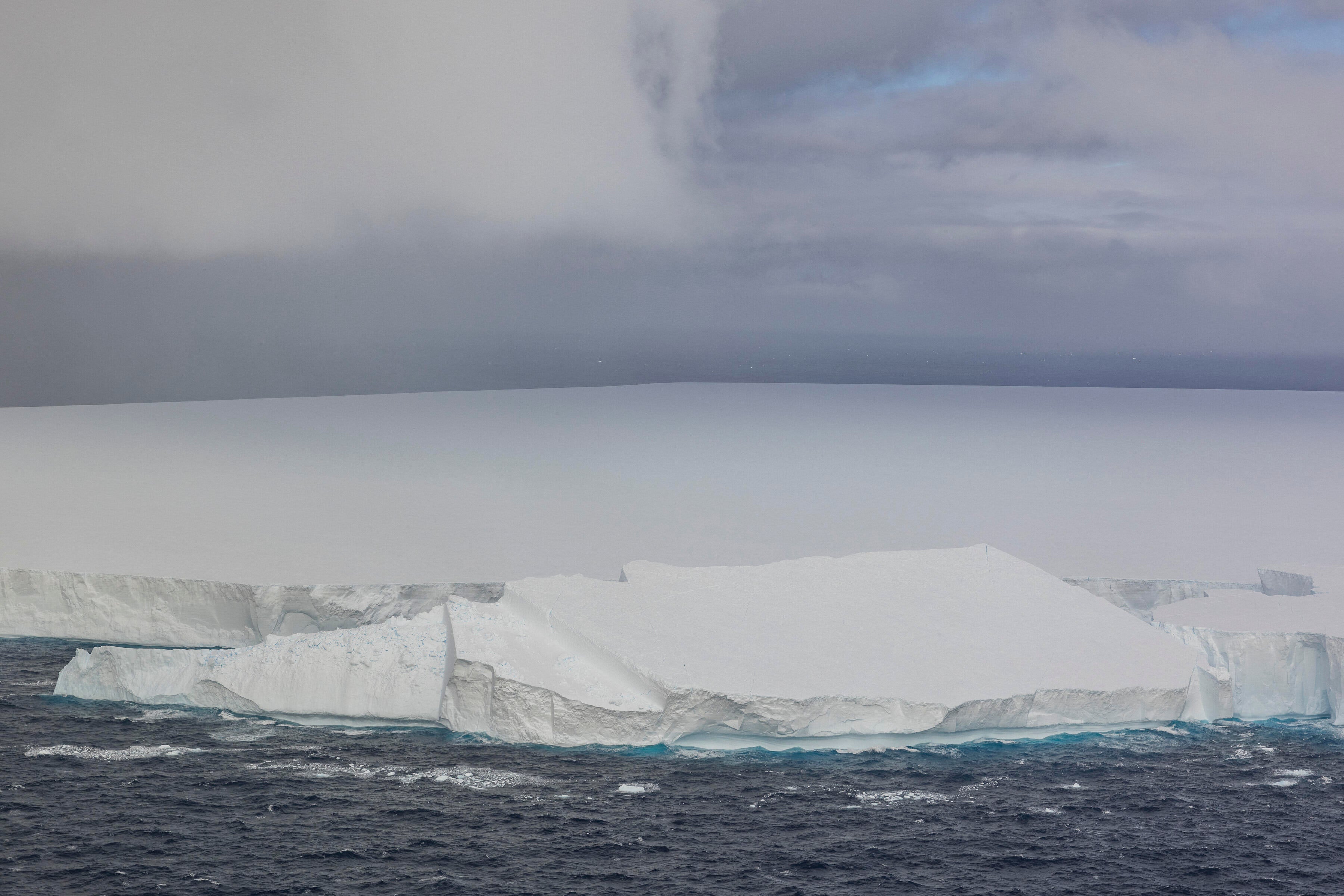
An aerial view of iceberg A23a during a British Royal Air Force flight on November 24, 2024, in the South Atlantic Ocean near South Georgia and the South Sandwich Islands. Photo by UK MOD Crown Copyright via Getty Images
The world's largest and oldest iceberg, named A23a, has run aground in shallow waters off the coast of South Georgia, a remote island in the South Atlantic known for its populations of penguins and elephant seals.
The "mega-berg," as some call it, is a sprawling ice sheet that once covered around 1,500 square miles but on its journey northward from Antarctica lost about 200 square miles of mass. Either way, the near-trillion-ton giant is larger than the state of Rhode Island, with towering cliffs that at certain points top 1,300 feet. It cracked off from continental Antarctica in 1986 and got stuck in the Weddell Sea, where it remained grounded for about three decades, according to the British Antarctic Survey, a research group focusing on polar science. The group has a station in South Georgia, which is a British territory.
The iceberg looks like a "towering wall emerging from the ocean, stretching from horizon to horizon," said British Antarctic Survey oceanographer Andrew Meijers in remarks published by the research group. Meijers studied A23a while aboard the ship RSS David Attenborough in late 2023.
A23a started to drift up through the Southern Ocean in 2020, when currents put it on a possible collision course with South Georgia. The iceberg and the island are about the same size in square miles. Researchers describe its path toward South Georgia as both meandering and intriguing, as the iceberg has charted a somewhat unexpected route to the island and became trapped last year in a rotating column of water that for months left it spinning in place.
At this point, the iceberg appears to be grounded in the shallow continental shelf around South Georgia, settling roughly 50 miles from the island's southwestern coast, according to the British Antarctic Survey. Meijers, citing satellite images, said it seems to be intact right now. But the iceberg will likely break into smaller chunks and begin to melt shortly afterward, in a process that could interrupt shipping operations and disrupt fisheries in the surrounding region.
"Whilst the berg is large it is easily avoided by Southern Ocean shipping operators — who are well aware of the dangers bergs pose, and the location of A23a. However, as it breaks up over time, the smaller bergs are much harder to track," Meijers said. "Discussions with fishing operators suggests that past large bergs have made some regions more or less off limits for fishing operations for some time due to the number of smaller — yet often more dangerous — bergy bits."
Meijers said there's less of a concern about the effects A23a could have on South Georgia's seals and penguins, although huge chunks of ice in the island's vicinity could possibly thwart their paths to feeding sites and result in less food and higher mortality rates for pups and chicks relying on them.
But the melting iceberg may also bring positive changes to the environment, Meijers added, by dispensing huge amounts of nutrients into the water that, in turn, "could actually boost populations of local predators like seals and penguins."
While Meijers noted icebergs like A23a are normal parts of the Antarctic life cycle, human-caused climate change has accelerated the process over the last couple of decades. Since 2000, researchers have recorded ice shelves losing about 6,000 gigatons of their mass, he said. One gigaton is equal to 1 billion metric tons, or 2.2 trillion pounds.
"This loss of ice shelf mass has significant implications for ocean circulation due to the addition of freshwater, acceleration of sea level rise ... and possible irreversible 'tipping points,' particularly in the vulnerable west Antarctic," Meijers said.?"These are pressing and active areas of research at BAS and elsewhere."
Source
|