The world's largest whales likely consume about 10,000,000 pieces of microplastic every day off California's coast, study finds
Posted by Temmy
Wed, November 02, 2022 1:01pm

The largest animals on Earth are having their health jeopardized by some of the smallest manmade objects. A new study found that filter-feeding baleen whales off of the California coast are ingesting millions of pieces of microplastics every day - a consumption that could be toxic.
Plastic pollution is an issue that has continued to plague the environment, particularly the ocean. Earlier this year, the Organization for Economic Cooperation and Development (OECD) issued a report saying that the world is producing "twice as much plastic as two decades ago" - with much of it leaking into the environment. OECD countries, including the U.S., account for 35% of microplastics leakage, the group found, an effect that poses a "serious concern."
This problem is only expected to get worse in the coming decades, and according to researchers, large marine animals may be at "extreme risk" of ingesting these plastics, which are tiny, synthetic polymers less than 5 millimeters long - about the size of an eraser on a new pencil.
In a study published in Nature Communications on Tuesday, researchers said that the highest concentrations of those microplastics are between 50 and 250 meters (164 to 820 feet) below the ocean surface - the same depths where baleen whales predominantly feed. Baleen whales - including the 29 fin whales, 126 blue whales and humpback whales the researchers studied off of California's coast - are filter-feeders, meaning that rather than chomping on fish, most of their diet is from taking in large gulps of water and ingest the numerous tiny animals within it, namely, krill.
Researchers studied whales from 2010 to 2019, primarily around Monterey Bay, to get a better understanding of just how much plastic they were ingesting. They found that krill-feeding whales are exposed to significantly more microplastic pollution.
"They're not just simply eating individual prey items. And so they can perhaps, get a lot of their plastic just through straining polluted water, or from prey items that had previously eaten plastic," Matthew Savoca, one of the study's authors, told CBS News.
Savoca said that researchers believe "98-99% of the all the plastic they're ingesting" is coming from their prey rather than directly from the water itself.
Among the whales included in the study are blue whales, the largest animals on the planet, which can weigh up to 330,000 pounds, grow up to 110 feet long and live to be around 90 years old. In what Savoca described as a conservative estimate, members of this species along California's coast were found to consume about 10 million pieces of microplastic - up to 96 pounds - every day, "or maybe even more."
A whale that feeds mostly on fish, on the other hand, consumes about 200,000 pieces a day, the study found.
Savoca did note, however, that whales are variable in their eating habits and "might not eat for days, weeks or even months at a time," particularly when they're breeding.
"Whales either eat an absolute massive amount of food, or none at all, and they can switch back and forth pretty impressively," he said.
Researchers, led by Ph.D. candidate Shirel Kahane-Rapport, were able to determine these numbers by cross-examining estimates of how much microplastic pollution is in the regions they analyzed, how much of that plastic is being consumed by krill and how much krill is being consumed by the whales.
Most of the microplastic comes from semi-synthetic fibers from clothes, furniture, rope and other materials.
"It's worth stating that these blue whales, for example, might eat 10, 15 or even 20 tons of food a day. So, the amount of plastic they're eating compared to the amount of food they're eating is minuscule," Savoca said. "That doesn't mean it's not important or dangerous."
Researchers are concerned that even though plastic ingestion is small compared to how much the animals eat, it could still have a toxic impact.
Plastics are made with chemical additives, Savoca said, and while many of those additives can diffuse into the ocean water, many others remain on the plastic pieces that are ingested. Many plastic pieces also become a "cocktail of contaminants" as other contaminants in the water attack themselves to the pieces, he said.
It's not yet completely clear how that plastic interacts with the animals' digestive systems, though it is being researched.
"The amount of plastic that we found that these whales might be ingesting suggests that perhaps these toxins could have effects that we aren't yet well aware of," he said. "Not just for whales, but for other animals that eat plastic, too. ... This is totally not a program unique to whales; it's almost universal at this point."
Some microplastics are even smaller than 5 millimeters, he said, and have been shown to be able to pass through the gut wall and into body tissues of humans. Scientists discovered microplastics in human stool in 2018 and earlier this year, in lung tissue. Savoca said it's also been detected in human placentas, breast milk and blood.
"This is the world that we all live in and these same issues we're talking about a whale...that's also us," he said. "...This is an issue that animals are acting as sentinels in some ways. They are canaries in the coal mine for these ecosystems and these food webs and these food chains that we are a part of too."
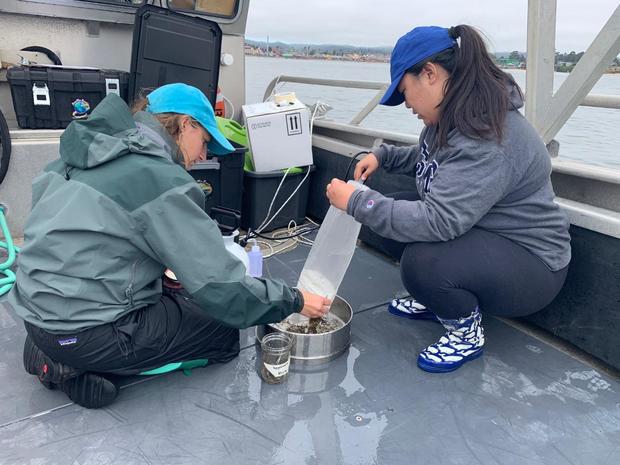
Researchers took water samples off California's coast to determine how much microplastics were infiltrating the water where baleen whales feed. MATTHEW SAVOCA
Source
|